The Stablecoin Shift: Why Fintech Infrastructure Is Quietly Changing
Stablecoins are becoming fintech infrastructure, changing how companies think about settlement, cross-border payments, treasury, and product
In 2025, Stripe paid more than $1 billion to acquire Bridge — a stablecoin infrastructure startup that most consumers had never heard of. Earlier that same year, Visa expanded USDC settlement into its core settlement operations. Mastercard joined Paxos’ Global Dollar Network. Klarna began raising short-term funding from institutional investors denominated in USDC. The companies at the center of how money moves globally are restructuring around a settlement layer that did not exist at meaningful scale three years ago.
This is a payments infrastructure story, not a crypto story. But this fact shouldn’t bore you, since the companies that understand the distinction are building for it.
The numbers that changed the conversation
The global fiat-backed stablecoin supply exceeded $273 billion in March 2026, growing 40x from $6.8 billion in March 2020, based on Allium and Visa data. In 2025, adjusted stablecoin transaction volumes grew 91% to $10.9 trillion — rivaling Visa’s $14.2 trillion of annual payments volume. Real-world stablecoin payments volume doubled in 2025 to $400 billion, 60% of which is estimated to be B2B payments.
These are not speculative or trading volumes. The $400 billion in real-world payments — cross-border B2B transfers, treasury operations, payroll for remote workers, marketplace payouts — represents a structural shift in which rails global money actually travels on.
The regulatory catalyst
Two regulatory milestones in 2025 unlocked institutional participation that had been sitting on the sidelines.
In the United States, the GENIUS Act, signed into law mid-2025, created a federal framework for payment stablecoins, clarifying reserve requirements, issuer oversight, and consumer protections. The law resolved years of ambiguity that had kept major institutions on the sidelines. In Europe, MiCA’s stablecoin provisions took effect simultaneously, creating the first regulatory framework for e-money tokens and asset-referenced tokens — with Circle’s USDC compliant and Tether’s USDT notably not.
USDT’s market dominance declined from 71.1% to 59.9% between early 2024 and 2025, while compliant alternatives including USDC, RLUSD (Ripple), and PYUSD (PayPal) steadily gained share — reflecting a broader reallocation toward institution-ready issuers as regulatory clarity improved.
What companies are actually building
The infrastructure layer is where the most significant construction is happening. Circle launched its Circle Payments Network (CPN) in 2025, connecting financial institutions, digital challenger banks, payment companies, and digital wallets to process payments instantly in different currencies through stablecoins. Circle also announced Arc, a new blockchain purpose-built for stablecoin finance with USDC for native gas, built-in FX engine, instant finality, and opt-in privacy.
Stripe’s Bridge acquisition was not a consumer product play. Stripe is approaching stablecoins as a developer primitive rather than a consumer product. After re-entering crypto infrastructure in 2022, the Bridge acquisition marked a decisive shift toward stablecoin-native payments and treasury tooling. Stripe is embedding stablecoin functionality into APIs for payouts, wallet balances, and card issuing. Early pilots include stablecoin-funded corporate card settlement and cross-border netting using USDC.
Coinbase rolled out a white-label stablecoin issuance product aimed at corporations and banks. SoFi launched an enterprise stablecoin. Fiserv announced it was entering the stablecoin business. PayPal introduced stablecoin financial tooling tailored specifically for AI-native businesses. The common thread is institutional and B2B infrastructure over consumer adoption.
The infrastructure argument for fintech builders
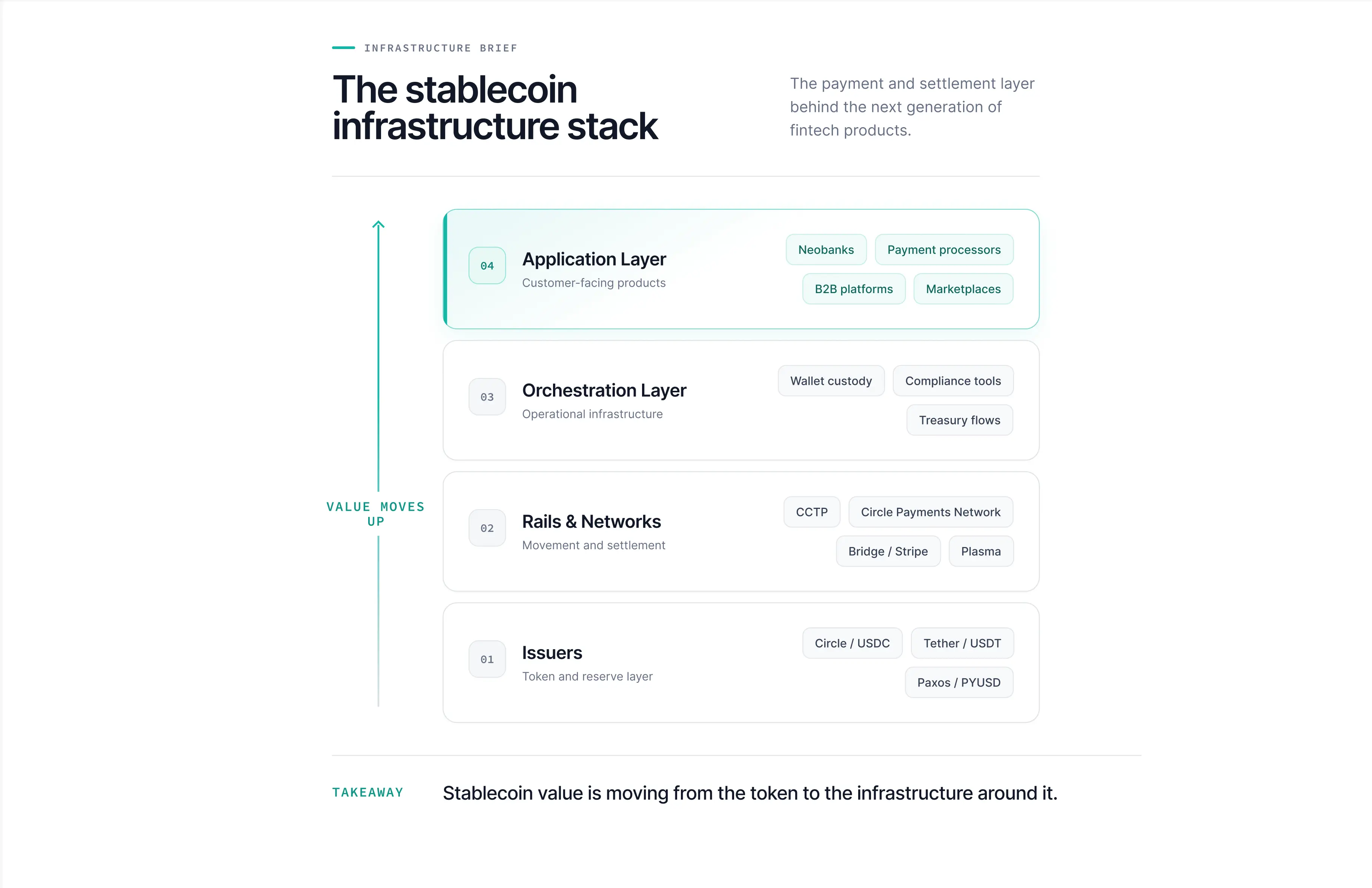
The real contest may not be over which stablecoin wins. We need to pay attention to who controls the systems around them — wallets, custody platforms, payment processors, compliance tools and settlement infrastructure. For fintech companies, this framing is the practical one:
the stablecoin itself is a commodity.
The value is in the stack that makes it usable for real business cases.
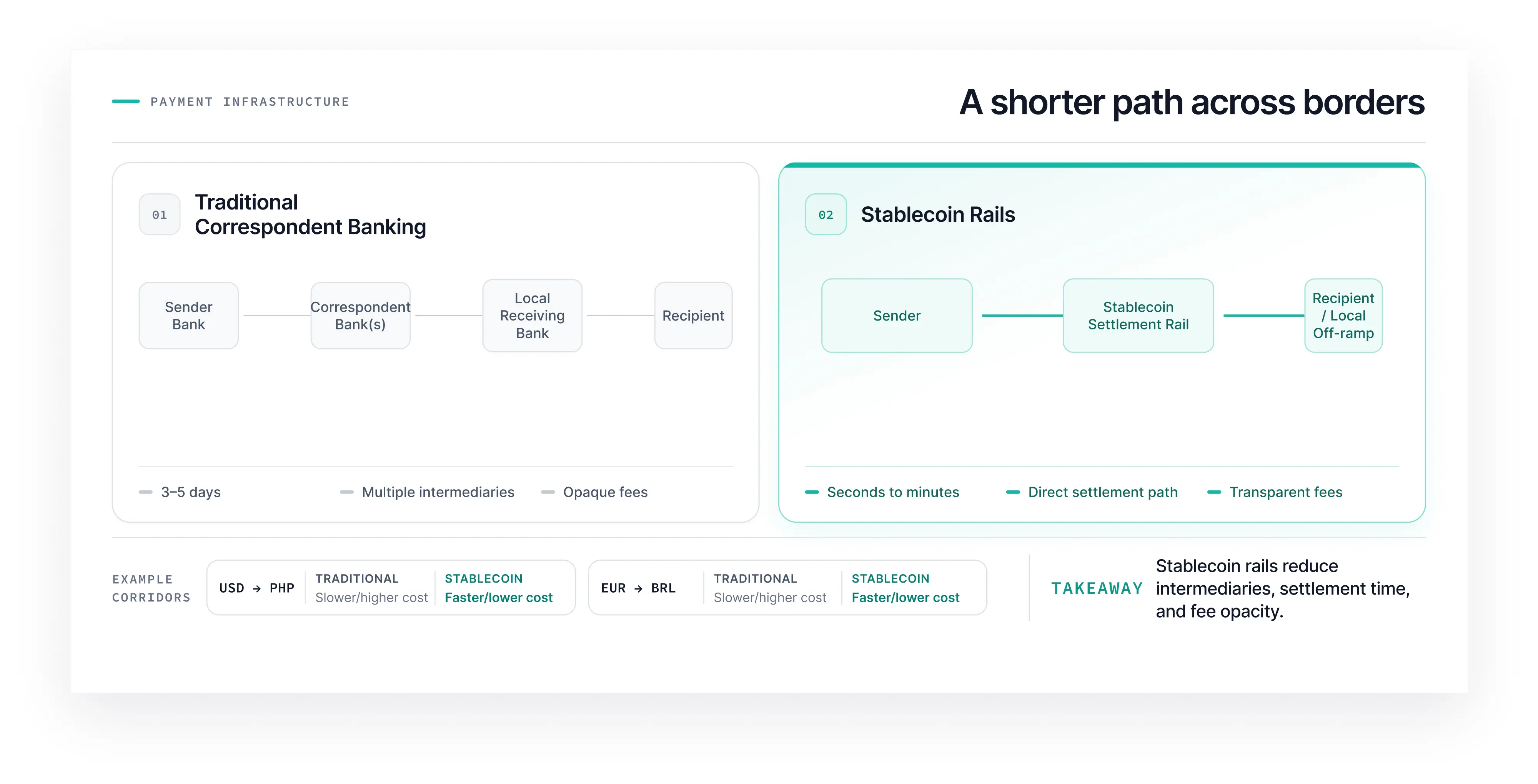
Stablecoins are being treated as settlement rails rather than trading pairs, stepping into roles historically dominated by correspondent banking networks and card schemes. Institutions are responding to practical advantages: programmability, fast finality, and clearer cost structures in a system where legacy rails remain slow and opaque.
For a cross-border payments company, this means re-evaluating whether the correspondent banking chain is still the best path for every corridor — or whether stablecoin settlement for specific high-volume corridors is now faster, cheaper, and more reliable. For a marketplace platform, it means evaluating whether instant payout to sellers via USDC outperforms the T+2 settlement cycle they’ve been explaining to merchants for years. For a neobank building treasury tools, it means deciding whether to support stablecoin balances alongside fiat.
The word “quietly” is the key one. Consumer interfaces won’t change. The settlement layer underneath them is already changing. By the time the shift is obvious to users, the infrastructure decisions will have been made — and the fintech companies that made them early will have a structural cost and speed advantage over those that waited for the mainstream moment.
Building a fintech product on next-generation payment rails? Unibrix has shipped Web3 wallets, staking platforms, and blockchain-integrated financial products — with the technical depth to build on both traditional and stablecoin infrastructure. The product layer is where the experience lives. The settlement rail underneath is an architecture decision.

Moombix

Kennitalan

Wooskill
technical assessment,
and project scoping.
UI/UX design, and
technical specifications.
reviews, and continuous
integration.
testing, security audits,
and bug fixes.
documentation, and
ongoing support.