Why Small Dedicated Teams Are Outperforming Large Engineering Departments
AI is changing the economics of software development. Smaller dedicated teams can deliver more by reducing coordination overhead, preserving
Gartner predicts that by 2029, 60% of organizations will adopt smaller software engineering teams at scale, up from 15% today. The reason isn’t simply lower costs. AI is changing what a small team can deliver — and making the overhead of large teams harder to justify.
Why bigger stopped meaning better
In The Mythical Man-Month, published in 1975, Fred Brooks described a problem familiar to engineering leaders: adding people to a delayed project can make it even later.
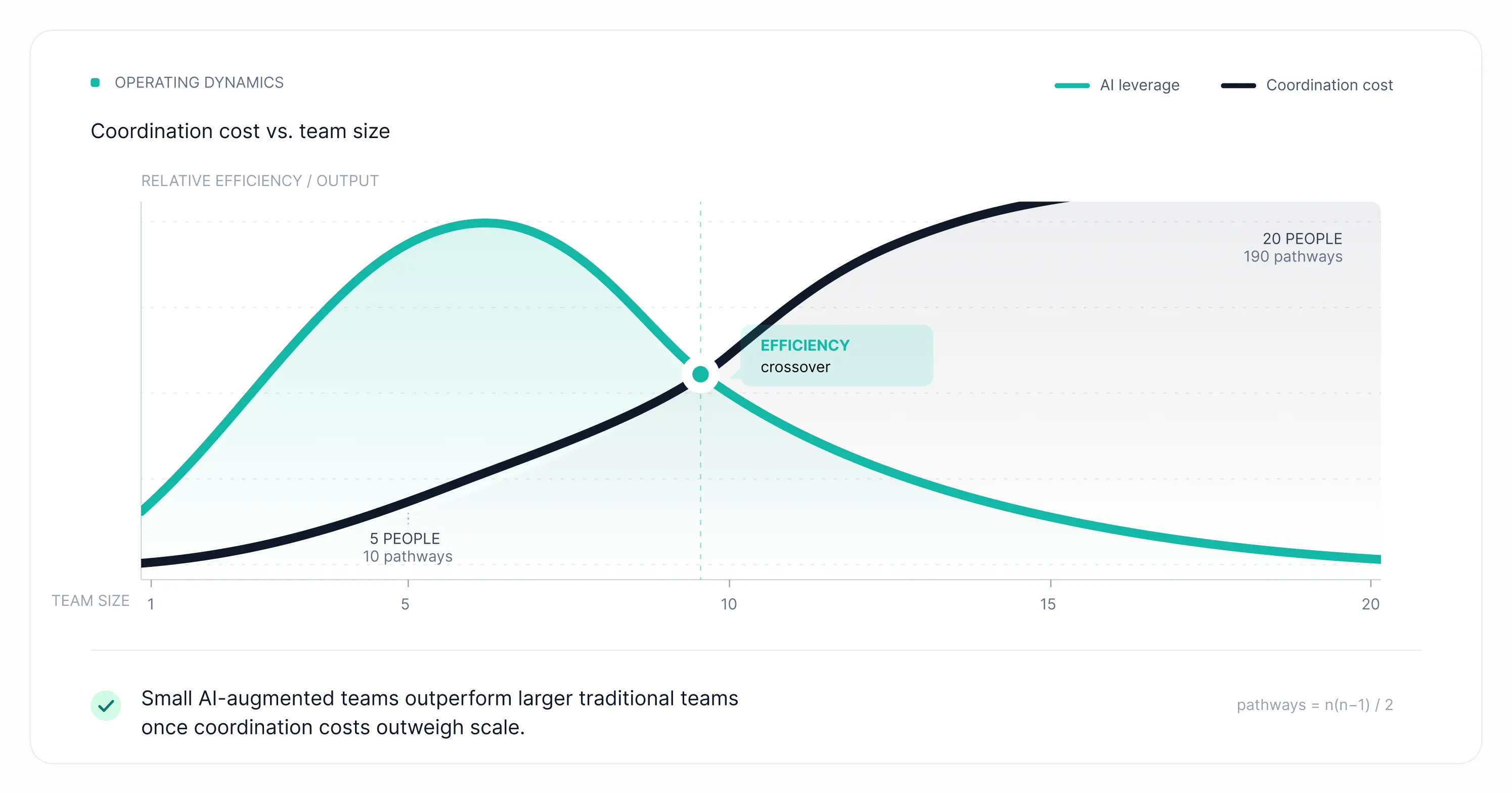
The reason is coordination. A team of five has 10 possible communication channels; a team of 20 has 190. As teams grow, more time goes into aligning people, sharing information, and keeping everyone on the same page.
For decades, the extra coordination was worth it because more engineers generally meant more development capacity. AI is changing that balance.
AI coding tools help developers move faster through implementation, testing, and other routine tasks. That leaves more room for architecture, product decisions, and complex problem-solving. Smaller teams can now take on work that previously required more people.
The products haven’t necessarily become simpler. Individual developers have gained more leverage.
What Gartner calls “tiny teams”
Gartner’s point is that a tiny team isn’t simply a smaller team doing the same work. It’s a group of experienced people using AI to handle more work, with humans focusing on decisions, direction and oversight.
A typical setup might include a product manager, a UX or agent experience (AX) designer, and at least one engineer who knows how to build with AI. Other specialists can join when needed. People take on broader responsibilities, moving between business goals, product design and managing AI agents that handle parts of the development work.
Notably, buying AI tools and changing how a team works with AI are two very different things. Companies that simply gave developers code assistants saw modest improvements. Those that changed their team structure — with fewer coordination layers, broader responsibilities and AI agents handling more implementation work — saw much bigger gains.
The numbers point in the same direction. Full Scale’s research on distributed engineering teams found that companies with well-structured teams had 42% higher sprint completion rates. Platform engineering teams with mature AI-assisted practices also report a 40–50% reduction in developers’ cognitive load.
The dedicated team advantage
One advantage of small engineering teams is often overlooked: they know the product inside out.
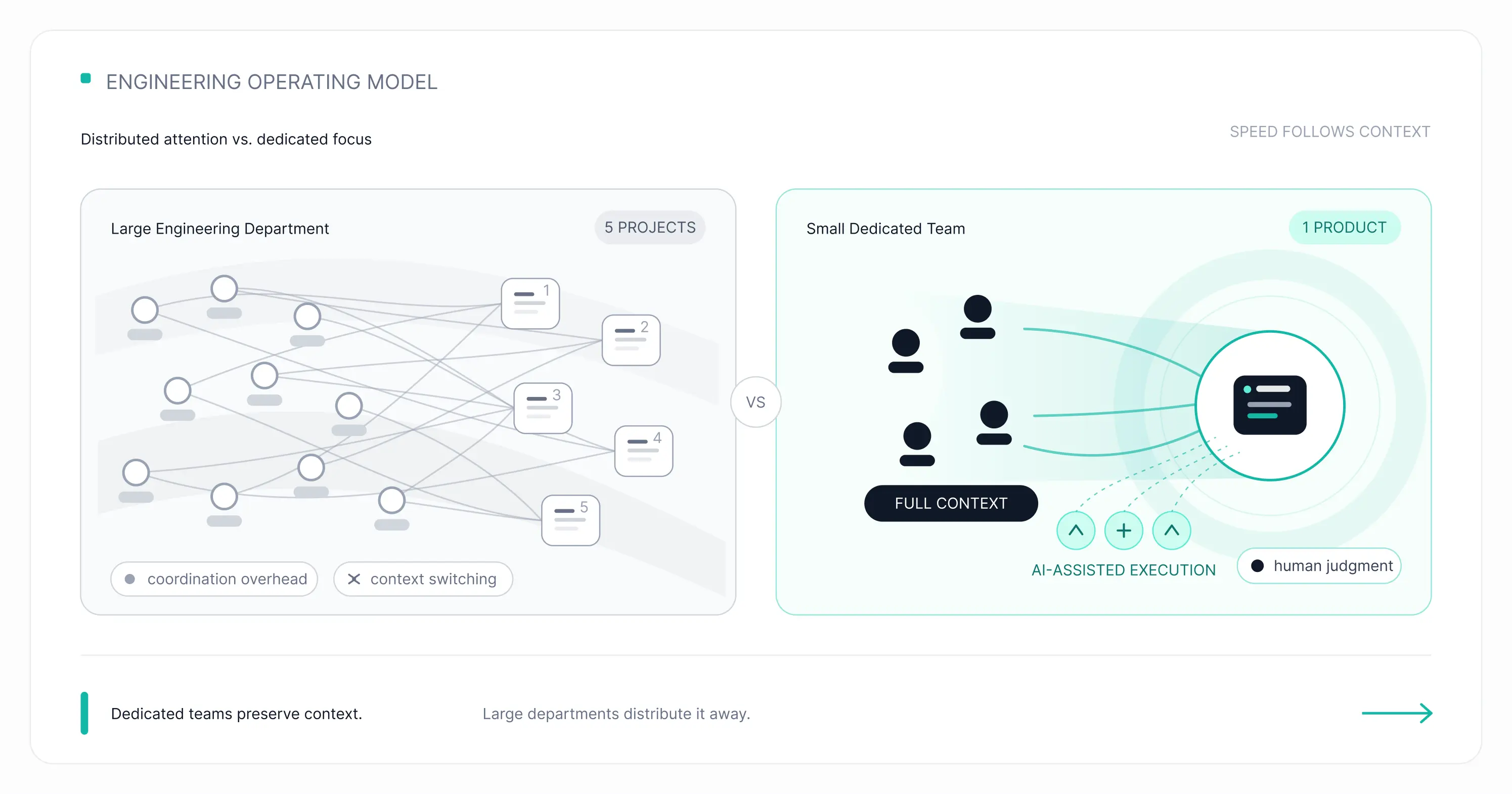
In large departments, engineers are often spread across several projects, products and stakeholder groups. They switch between tasks, revisit old decisions and spend time getting back up to speed. An engineer splitting their time between two products rarely has the same understanding of either as someone who works on it every day. This constant switching takes time and makes it harder to stay focused.
A small team working on one product over time builds a much deeper understanding of it. They know why certain technical decisions were made, which shortcuts might cause problems later and how customers actually use the product, beyond what the original specifications say.
This is one of the main differences between a dedicated development team and staff augmentation. Staff augmentation gives you more people. A dedicated team brings continuity and a deeper understanding of the product. Over time, that knowledge becomes a real advantage: less time spent explaining, fewer repeated mistakes and better decisions as the product grows.
What this means for how companies build
In 2026, the fastest-moving companies were making smarter decisions about how they build their engineering teams. They know where human experience and judgment matter, and where AI can take over routine work. Their teams are organised around that balance.
Gartner warns that smaller teams shouldn't mean hiring fewer junior engineers. Cutting junior roles may save money now, but it creates a gap in the talent pipeline. By 2028–2029, as senior engineers retire, companies could find themselves without enough experienced people to replace them. Small teams still need a mix of skills, experience and the ability to take on different tasks.
For engineering leaders, this means rethinking how teams work. Smaller teams need clear ownership, more autonomy and faster feedback. With the right AI tools, three people can now handle work that once took five, while still keeping the experience and skills needed to grow the team over time.
Building a product with a small, dedicated team? Unibrix operates as a dedicated software development partner — not a body-shop, not a ticket queue. Small, senior, context-rich teams that stay with the product long enough to know it the way your own team would. That model is what makes AI-augmented small-team development actually work.

Moombix

Kennitalan

Wooskill
technical assessment,
and project scoping.
UI/UX design, and
technical specifications.
reviews, and continuous
integration.
testing, security audits,
and bug fixes.
documentation, and
ongoing support.