Search Is Dead. Discovery Is Becoming Personalized Infrastructure
Search is evolving from keywords to personalized discovery powered by behavioral signals, embeddings, ranking models, and feedback loops.
Over two in five Americans now use TikTok as a search engine. One in ten Gen Zers relies on it more than Google, according to an Adobe survey. Among users aged 18-24, 34% use TikTok for search and discovery — and 40% prefer video recommendations over written reviews. A generation of users has grown up inside a system that does not wait for them to ask questions. It infers what they want and surfaces it before they know to look.
This is not a social media trend, but rather an infrastructure demand. The question for product teams, platform builders, and fintech companies now wraps around building the engine underneath personalized discovery which has already been replacing keyword search.
The shift from intent graph to interest graph
Traditional search engines — Google, Bing, even the search bars of most SaaS products — are intent-based. The user knows what they want, forms a query, and receives results ranked by relevance to that query. The system is reactive. It serves demand; it does not create it.
TikTokʼs For You Page (FYP) is built on an interest graph instead of a social graph. It does not primarily optimize for what your friends post. It relies on what you will engage with next, based on a continuous inference loop: watch time, replay frequency, scroll behavior, comment patterns, and hundreds of other implicit signals. The distinction is that the user never has to express intent. The system identifies interest and acts on it before the user forms a conscious preference.
The result is described in TikTokʼs own product documentation: recommendations are driven by user interactions, content information, and user behavior in combination — not by follower relationships. The FYP is a prediction engine, not a social feed. And 68% of TikTok Shop purchases in 2026 originate from AI recommendations rather than active search queries, according to industry analysis. Discovery has replaced intent as the primary purchase trigger on the platform.
This is not isolated to TikTok. Spotifyʼs Discover Weekly, which has been running since 2015, generates over 40 million listeners weekly — driven by collaborative filtering that identifies listening patterns similar to yours and surfaces music you havenʼt heard. Amazonʼs recommendation engine is responsible for an estimated 35% of its total revenue. YouTubeʼs recommendation system drives more than 70% of watch time on the platform. In each case, the most valuable surface in the product is not the search bar. It is the recommendation engine.

What the engine actually requires
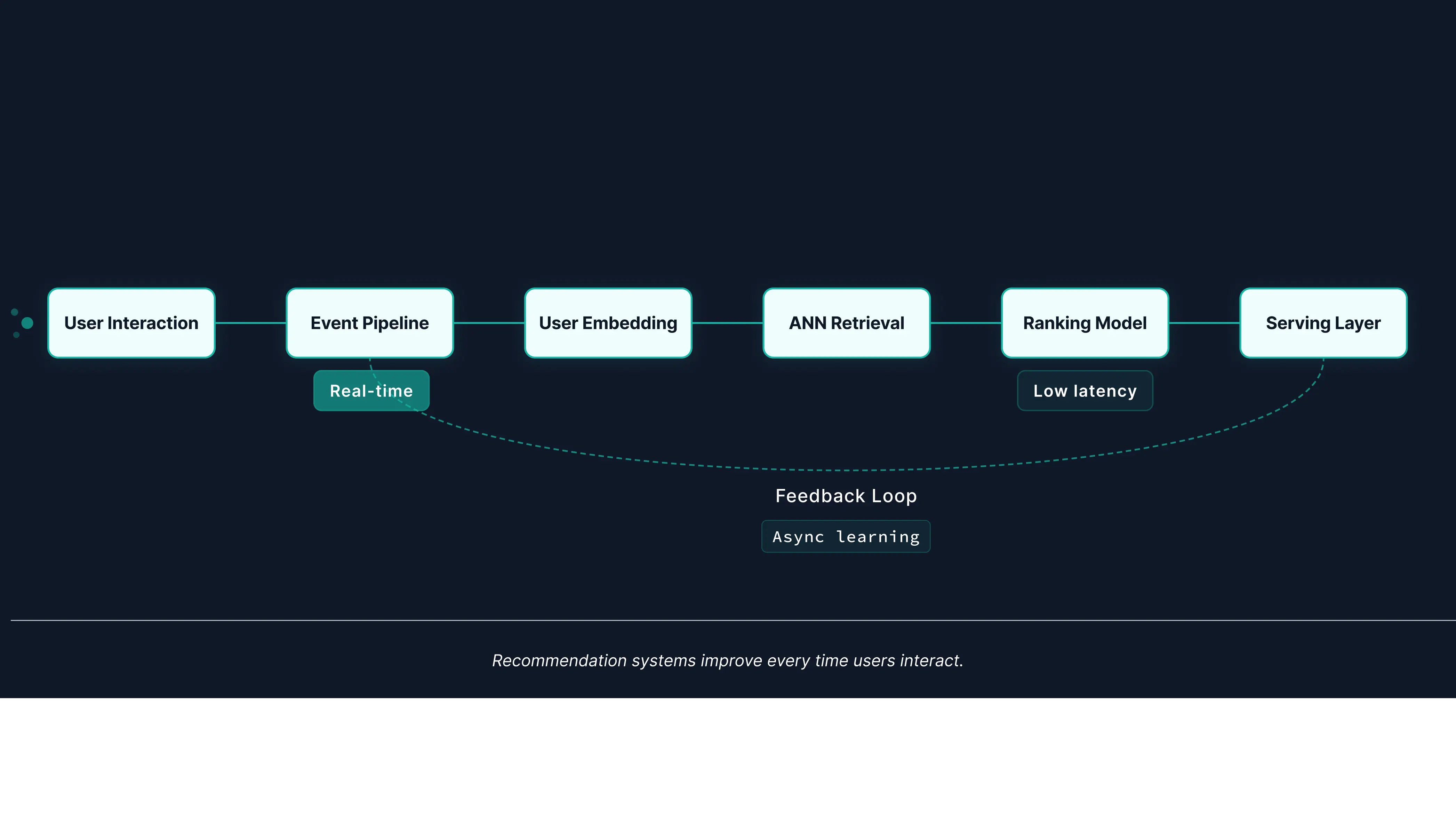
Building a recommendation system that produces meaningful personalization at scale is a different engineering problem from building a search index. The components are distinct:
User modeling. Every interaction — explicit (likes, saves, ratings) and implicit (watch time, scroll depth, click patterns) — must be captured, stored, and used to maintain a continuously updated representation of user preferences. This representation, typically a learned embedding in a vector space, is what the recommendation system queries when selecting candidates.
Candidate generation. Given a user model, the system must efficiently retrieve candidates from a corpus that may contain millions or billions of items. Approximate nearest neighbor (ANN) search against a vector index is the dominant approach — retrieving items whose embedding is similar to the userʼs current interest vector. Tools like FAISS, Pinecone, and Weaviate have made this accessible to teams that donʼt have Google-scale infrastructure.
Ranking. Candidate generation produces a set of potentially relevant items. Ranking determines which of those candidates to show, in what order, on what surface. A ranking model is trained to predict engagement — the probability that a specific user will click, watch, purchase, or otherwise engage with a specific item. The ranking model needs labels (actual engagement outcomes) and features (user context, item metadata, contextual signals like time of day and session history).
Feedback loop. The recommendation system improves through use. Every engagement event is a label that improves the model. The speed at which the feedback loop closes — how quickly engagement outcomes are incorporated into updated rankings — determines how quickly the system personalizes.
Why this matters for fintech and SaaS builders
The relevance extends well beyond consumer media. Fintech platforms with large product catalogs — insurance comparison, investment options, lending products — are applying recommendation infrastructure to surface the most relevant product for each userʼs financial situation, rather than expecting users to navigate a menu. The conversion lift from recommendation-driven product discovery over menu-driven search is consistent across verticals: users engage more with products that feel chosen for them.
The shift is the same as TikTokʼs. Not “what is the user looking for?” but “what will be most useful to this user, right now, given everything we know about them?” That question requires an interest graph. Building it requires an infrastructure investment that is distinct from, and architecturally more complex than, a search index.
Building a discovery or recommendation engine? Unibrix builds the recommendation infrastructure that powers personalized product discovery — from user modeling and vector search to real-time ranking and A/B testing frameworks. The gap between a search bar and a recommendation engine is an architecture decision, not a feature request.

Moombix

Kennitalan

Wooskill
technical assessment,
and project scoping.
UI/UX design, and
technical specifications.
reviews, and continuous
integration.
testing, security audits,
and bug fixes.
documentation, and
ongoing support.