Your CRM Is Probably Becoming an AI Agent
CRM is moving from storing data to taking action. See how AI agents are reshaping sales automation and customer management.
In 2024, CRM AI meant suggesting an email draft. In 2026, it can qualify a lead, research their LinkedIn profile, write an outreach message, schedule a follow-up, update the pipeline, and flag an opportunity as at risk if the lead goes quiet for seven days — all without a person initiating each step.
That changes what a CRM is. It used to be a place to store customer information and track sales activity. Now, it can also take action. And that has implications for every team that relies on one.
Three generations in eight years
Salesforce’s product history shows how quickly things have changed.
In 2016, Einstein introduced predictive AI that scored leads and suggested next steps. In 2023, Einstein GPT added generative AI to draft emails, summarize calls, and write support responses. In 2024, Agentforce brought autonomous agents that can plan and carry out multi-step tasks without someone prompting them at every stage.
Each generation does something different: predictive AI estimates what might happen, generative AI creates content, and agentic AI takes action.
By April 2026, Agentforce ARR passed $1.2 billion, up from $540M at the end of 2025, with 29,000 customer deals closed.
Its Atlas Reasoning Engine combines large language models, action models, and retrieval-augmented generation to handle tasks such as lead qualification, support triage, and pipeline management. Salesforce’s Einstein Trust Layer controls what agents can access, what they can access and do, while keeping an audit trail of their actions.
HubSpot responded with Breeze AI — embedded across every Hub without a separate licensing tier. Its Prospecting Agent researches leads, finds decision-makers, and drafts personalized outreach. Its Customer Agent handles support requests using the knowledge base and CRM history.
In April 2026, HubSpot also introduced outcome-based pricing: $0.50 per resolved conversation, rather than per conversation started. You pay when the agent completes the task.
That’s an important shift. The vendor’s revenue now depends more directly on whether the agent gets the job done.
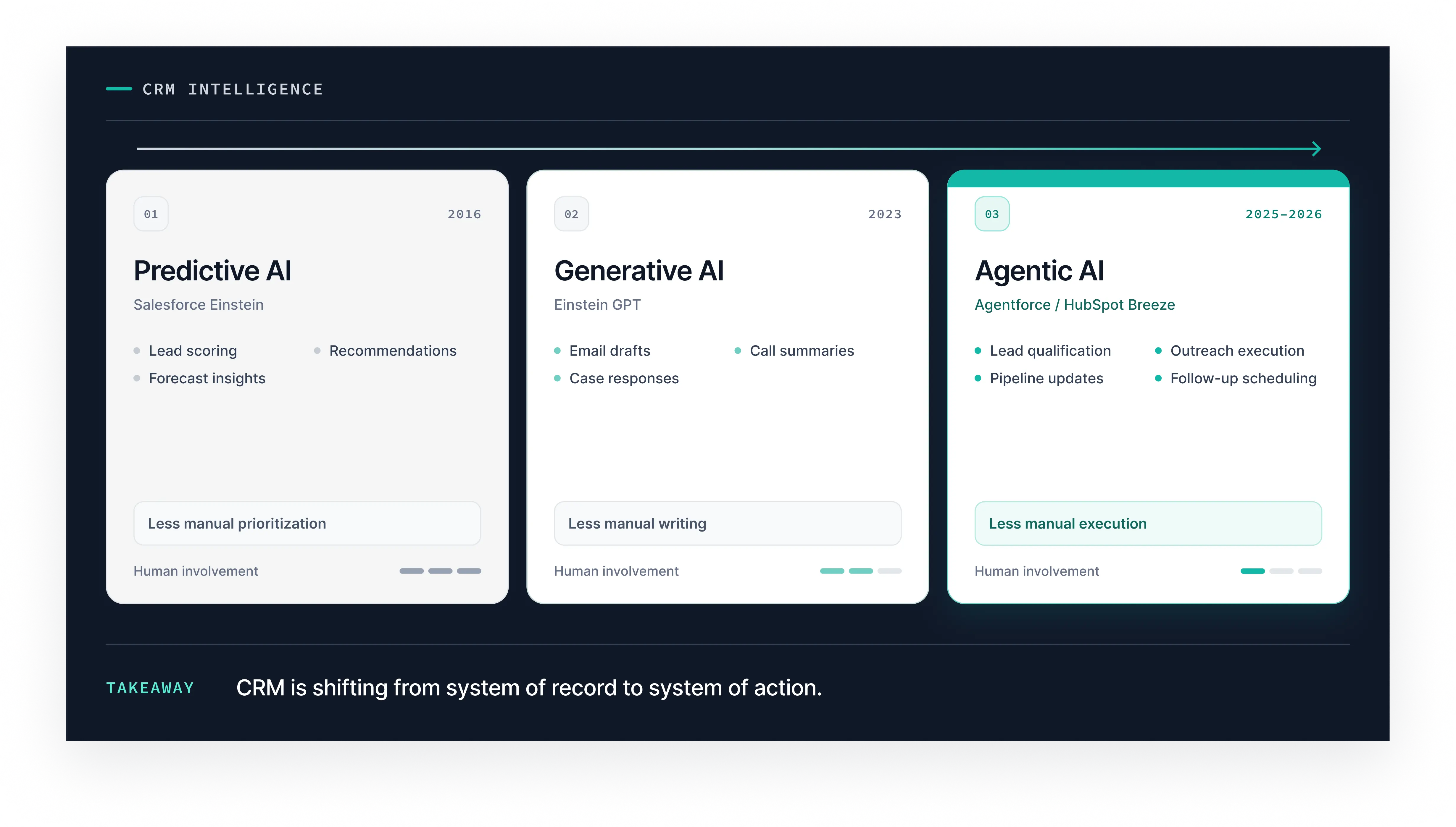
What agents actually do in a CRM workflow
Consider a customer who shows signs of leaving. An AI agent can review the account history, identify the risk, draft a personalized retention message, schedule it, log the activity in the CRM, and flag the account for human review if the response suggests a bigger problem.
Previously, a sales rep might spend half an hour on that work — or skip it altogether because doing the same for thousands of accounts would take too much time. An agent can handle the workflow across thousands of accounts at once.
According to Coffee.ai, an AI CRM vendor, AI tools save sales teams an average of 6.4 hours a week compared with traditional CRM workflows. For AI-native tools that automate data entry and enrichment as well, the estimate rises to 8–12 hours per rep each week. Across a 50-person sales team, that’s equivalent to six to ten full-time employees’ worth of time.
Salesforce’s 2026 State of Sales report found that 83% of sales teams using AI reported revenue growth over the previous year, compared with 66% of teams that didn’t use AI. The gap is worth watching, even if AI alone doesn’t explain the difference.
The data problem nobody talks about
There’s a catch: AI agents are only as useful as the data they work with.
Give an agent clean, consistent CRM records, and it can produce relevant outreach, better pipeline forecasts, and useful summaries. Give it duplicate contacts, missing fields, and inconsistent naming, and the results will be unreliable — no matter how advanced the model is.
The hidden cost of CRM AI often isn’t the software. It’s cleaning up the data before the agents can do their jobs. And when an AI rollout disappoints you, probably the issue may be the messy data underneath not the model itself.
The new challengers
Salesforce and HubSpot aren’t the only companies building AI-powered CRMs. A new group of AI-native products is betting that older platforms carry too much technical baggage to put autonomous agents at the centre of the product.
Lightfield focuses on “complete customer memory,” connecting inboxes and automatically updating the pipeline. Last month it reached over 5,000 companies and raised a total of $128 million. Monaco, founded by former Brex CRO Sam Blond, targets sales-led growth teams. Reevo raised $80 million from Khosla Ventures and Kleiner Perkins last year to rebuild the go-to-market stack around autonomous agents in 2026 and beyond.
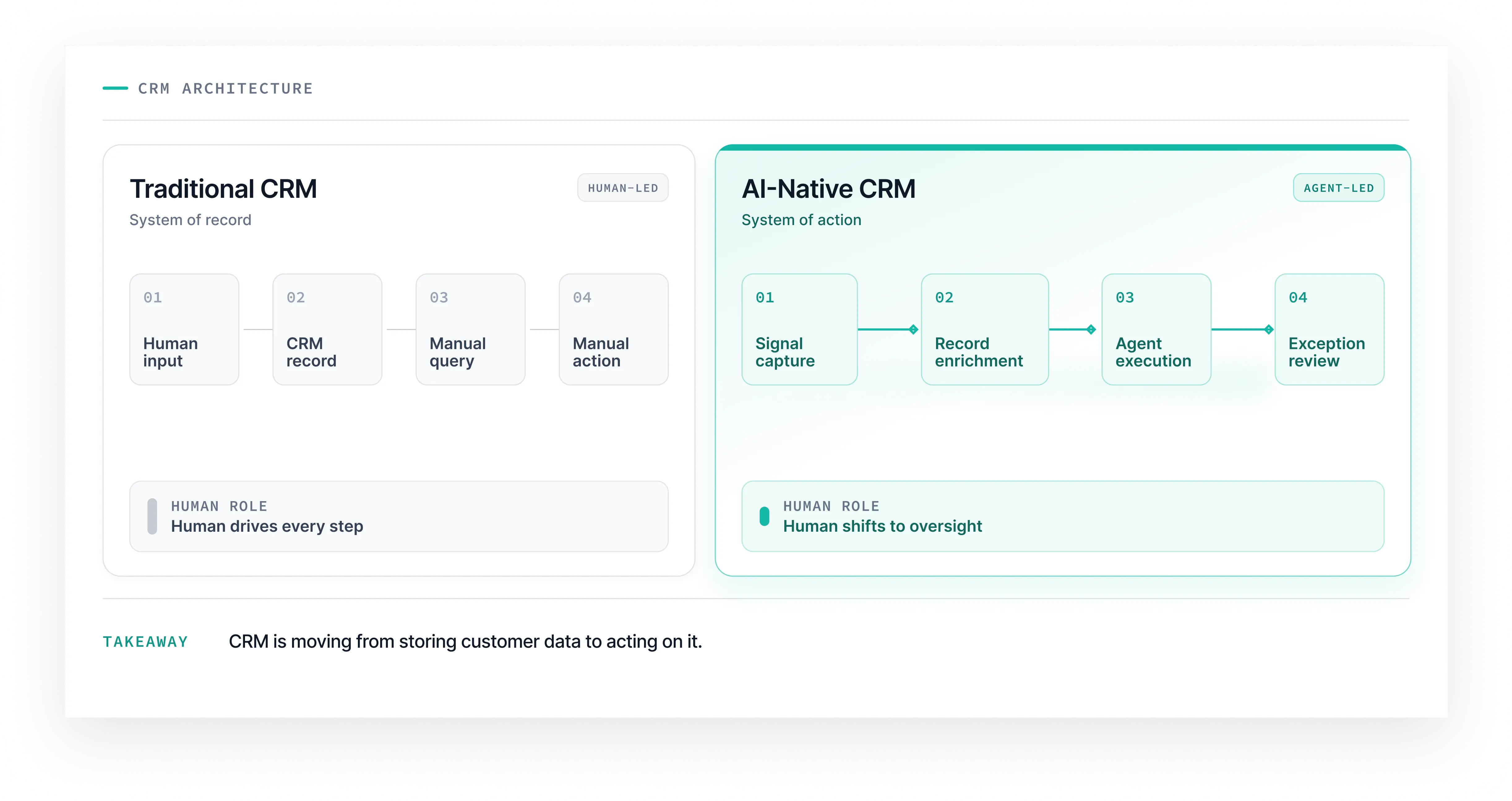
The CRM market is splitting between CRMs where AI is a feature and CRMs where the agent is the product. That distinction determines which companies will acquire and which will be acquired in the next three years.
Developing a product that integrates with or extends CRM workflows? Unibrix builds custom CRM integrations, sales automation platforms, and AI-powered workflows. That could mean adding custom agents to Salesforce or HubSpot, or building a CRM for a specific industry from scratch.
The important decisions happen early: how the system accesses data, handles errors, manages permissions, and checks an agent’s work. Get those foundations right, and automation becomes much more reliable.

Moombix

Kennitalan

Wooskill
technical assessment,
and project scoping.
UI/UX design, and
technical specifications.
reviews, and continuous
integration.
testing, security audits,
and bug fixes.
documentation, and
ongoing support.