Why Nordic Startups Outsource Software Development Differently
Why Nordic startups outsource for expertise, speed, and scalability—and choose technical partners over traditional vendors.
Sweden produces more tech unicorns per capita than any country outside Silicon Valley. With roughly 27 unicorns from a population of 26 million people, the Nordic region has generated Spotify, Klarna, Rovio, Bambora, King, iZettle, and Mojang — brands that are globally recognizable — from a corner of the world with fewer people than California.
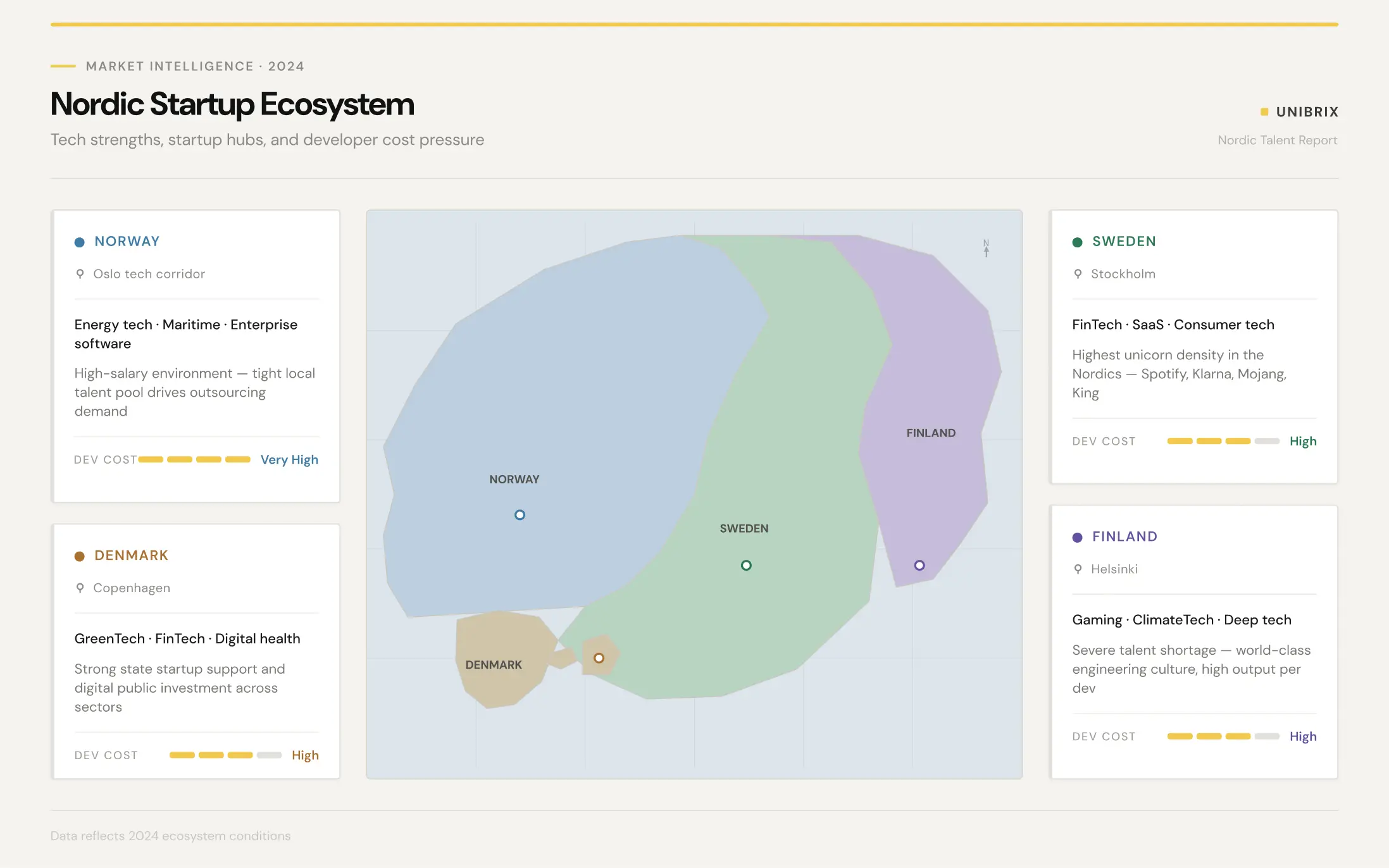
The Nordic startup ecosystem runs on a paradox: the talent density that produces world-class technology companies also makes it extremely expensive and difficult to hire the engineering teams those companies need to build at speed. Developer salaries in Norway, Sweden, Denmark, and Finland rank among the highest in Europe. Developer availability is constrained by unemployment rates that are among the lowest on the continent.
The result is a distinctive outsourcing culture — one that is not primarily about cost reduction, and is increasingly not about filling headcount gaps. It is about accessing specific expertise at the velocity the market demands.
What Nordic companies are actually outsourcing for
The data challenges the conventional narrative about outsourcing: 73% of Nordic outsourcers report satisfaction with their IT service providers — one of the highest satisfaction rates globally. More significantly, when asked why they outsource, the plurality answer is not cost. For application development and maintenance, 56% of Nordic companies outsource for scalability. Additional flexibility and specific expertise (technical depth in domains their internal teams donʼt cover) rank as almost equally important reasons. Cost efficiency is real but secondary.
This matters because it describes a fundamentally different vendor relationship. A Nordic startup outsourcing for expertise is not looking for cheaper developers to execute a defined spec. It is looking for a technical partner who can co-own a domain — who brings experience in the specific problem (payment rail integration, real-time data pipelines, mobile architecture, security compliance) that the internal team lacks.
The distinction shapes what a good partnership looks like in this context. It requires a vendor who will push back on the spec when the spec is wrong, who brings patterns from previous implementations rather than just executing the current one, and who can operate with minimal oversight. Nordic startup culture — shaped by flat hierarchies, high trust, and an expectation of professional autonomy — does not accommodate hand-holding vendor relationships. The partner is expected to perform like a senior hire, not a contractor.
The talent constraint in numbers
The Danish government, recognizing the structural shortage, allocated 134 million EUR to digital transformation initiatives running through 2025. Finland faces the most severe talent shortage among Nordic countries, with a projected IT skills gap extending through the decade. Sweden, Norway, and Denmark face similar structural recruitment challenges — strong demand, low unemployment, and a relatively small addressable talent pool compared to the scale of their startup ambitions.
The practical consequence: a well-funded Nordic startup building a FinTech or HealthTech platform cannot simply hire its way to the engineering team it needs in a six-month fundraise-to-launch cycle. The recruitment timelines donʼt support it. The salary competition from established tech companies doesnʼt support it. And for specific technical domains such as blockchain infrastructure, medical software architecture, and real-time data systems the local expertise pool may be genuinely thin regardless of budget.
The geographic outsourcing preference is instructive. Nordic companies frequently partner with Central and Eastern European development teams in Poland, Ukraine, Estonia, and Romania for nearshore outsourcing. The time zone overlap is workable (one to three hours difference), the technical education systems produce engineers in relevant domains, and the cost structure is meaningful (though not as extreme as offshore to Southeast Asia or India). Cultural proximity and communication norms also align more closely with Nordic expectations than more distant alternatives.
What the best Nordic partnerships look like
The Nordic startups that have scaled fastest through outsourced development partnerships share a pattern. They bring an outsourced partner in at the architecture stage, not the implementation stage — involving them in the technical design decisions that determine the platformʼs scalability before any code is written. They treat the partner team as permanent staff for the duration of the engagement, not as a rotating pool of contractors. And they measure the partnership on delivered product quality and speed-to-market, not on hours billed.
For the vendor, this means the relationship requires genuine domain expertise in the startupʼs vertical. A Nordic FinTech startup doesnʼt need a generalist development shop. It needs a team that has built payment integrations, KYC pipelines, and compliance architectures before — and can bring that institutional knowledge to the engagement from day one.
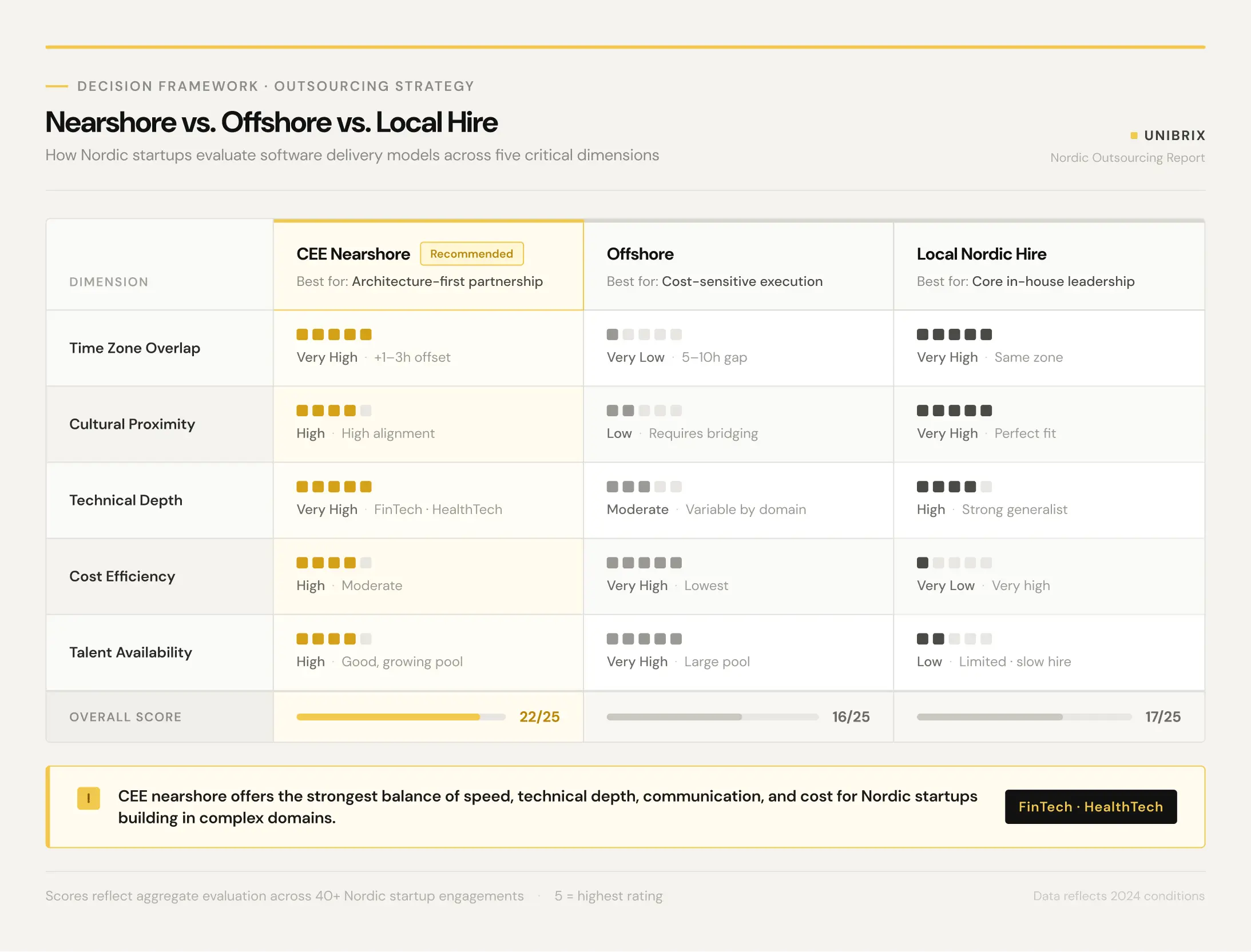
Nordic startup building at speed? Unibrix works with European founders and scaleups as a technical partner — bringing domain expertise in FinTech, HealthTech, and Web3, with the architecture-first approach that Nordic startup culture expects. The engagement starts at the design decision, not the ticket queue.

Moombix

Kennitalan

Wooskill
technical assessment,
and project scoping.
UI/UX design, and
technical specifications.
reviews, and continuous
integration.
testing, security audits,
and bug fixes.
documentation, and
ongoing support.