Why Marketplace Startups Fail at Scale
Munchery raised $125M. Beepi hit $525M. Both failed. The pattern behind marketplace collapse is consistent — and almost always preventable.
Munchery raised $125 million, expanded to multiple cities, and shut down in 2019 — still hemorrhaging cash on every order. Beepi, the peer-to-peer used car marketplace, hit a $525 million valuation in two years, burned $7 million a month, and was sold for parts when funding dried up. Webvan raised $800 million for online grocery delivery in 2001 and went bankrupt before Amazon bought Whole Foods and made the model work.
These werenʼt failures of ideas, but rather the sequencing failures. While the product and market were real, the timing was wrong and the unit economics were never fixed before scale was added on top of them.
Marketplace shutdowns follow patterns that are consistent enough to be predictive. The companies that avoid them share one characteristic: they treat scale as a reward for solving the model, not a strategy for finding it.
The two-sided trap
A marketplace has no product without both sides. No buyers without sellers. No sellers without buyers. This is the cold start problem, documented exhaustively in the literature since Andrew Chenʼs canonical essays on the subject — and it remains the first death trap for marketplace founders.
What makes the chicken-and-egg problem particularly dangerous is that the natural solution — subsidizing one side to attract the other — is also the path to unsustainable unit economics. Instacart succeeded where Webvan failed not because the idea was different but because Instacartʼs asset-light model, leveraging existing grocery store inventory and gig-economy shoppers, kept the subsidy manageable. Webvan built massive warehouses before proving the demand. The capital intensity of the solution didnʼt match the uncertainty of the problem.
The same mistake surfaces repeatedly. DoorDashʼs early strategy of personally delivering food orders, learning operations before automating them, is now a business school case study in sequencing. The founders didnʼt optimize the marketplace until they understood what they were optimizing.
The Startup Genome Project found that companies that scale prematurely have 20x lower growth rates and are 3x more likely to never exit. Premature scaling — defined as growing dimensions of the business before validating the core model — kills an estimated 70% of startups that fail this way. For marketplaces, the most common premature scale is geographic: expanding to new cities before the first market has positive unit economics.
What unit economics actually means for a marketplace
Contribution margin — revenue from each transaction, after subtracting variable costs — is the number that matters at the transaction level. Gross merchandise value (GMV) is vanity if the contribution margin is negative. A marketplace growing GMV while losing money on each order is building a bigger machine for losing money faster.
The math is compounded by take rate fragility. Most marketplaces charge a percentage of each transaction. The take rate thatʼs sustainable at an early scale — when neither side has alternatives — often erodes as the marketplace matures and both sides gain negotiating power. Uberʼs take rate compression over years of operation is the canonical example: what started as a margin-favorable model became structurally thin as drivers organized and riders gained alternatives.
CB Insightsʼ analysis of startup failures consistently places poor unit economics among the top three causes — appearing in 19% of documented failures — alongside product-market fit problems and competitive displacement. For marketplaces, all three failure modes are connected: poor unit economics force take rate increases that reduce competitiveness, which forces subsidies that worsen economics in a cycle.
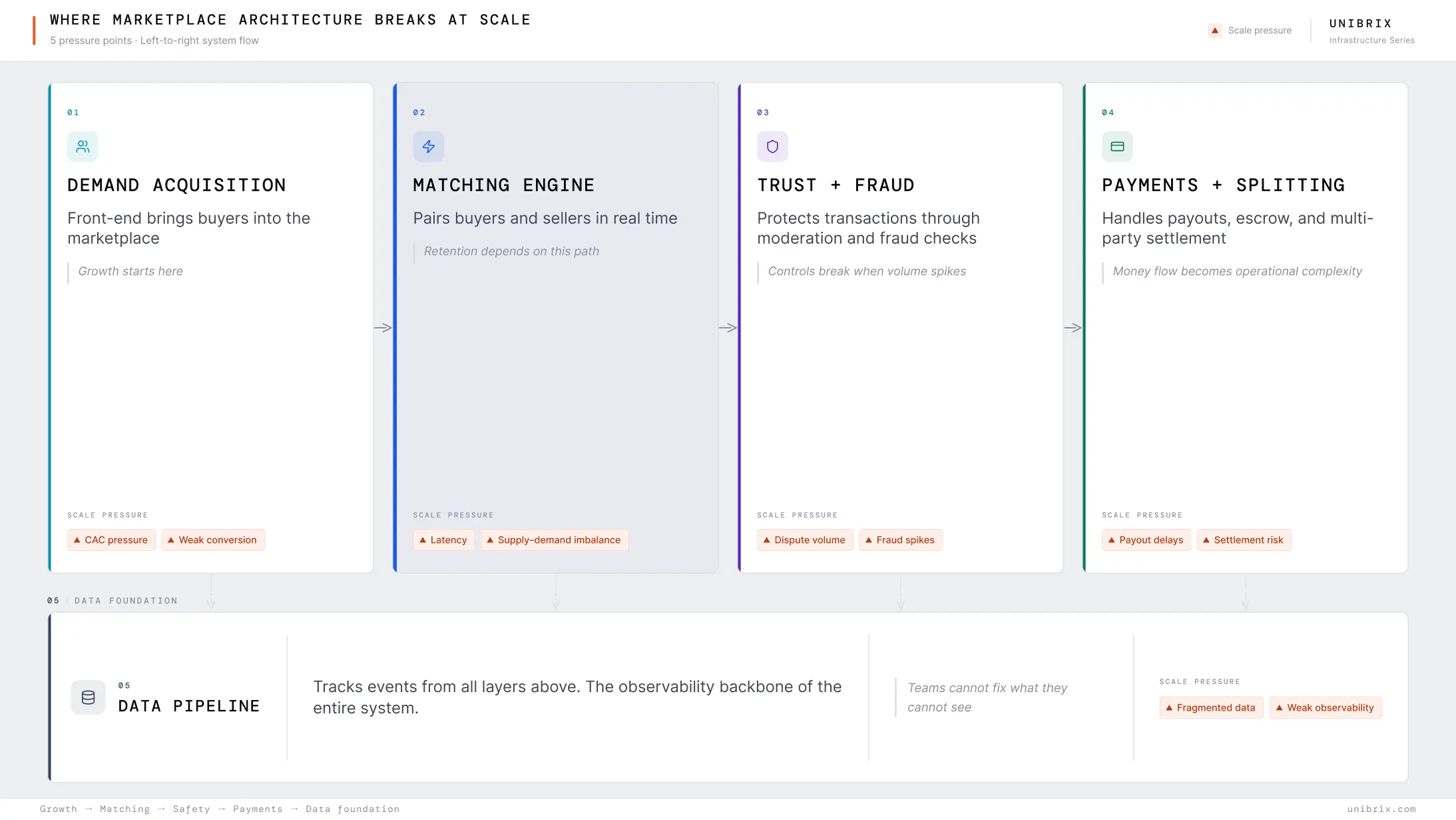
The technical scale cliff
Marketplace founders who survive the business model problem hit the engineering problem next. A marketplace that works for 10,000 transactions a day breaks in different ways at 1 million transactions a day. The matching algorithm that was hand-tuned for one city doesnʼt generalize. The fraud detection that worked by manual review at low volume becomes unmanageable. The trust and safety system that was a customer support ticket queue becomes a product requirement.
The platforms that scale cleanly share architectural decisions made early: a matching engine built for latency at volume, a payments layer that handles splits and escrow correctly before the edge cases appear, a trust system that treats review integrity as infrastructure rather than an afterthought, and a data pipeline that makes supply-demand imbalances visible before they become user experience failures.
Whatnot, which achieved $3 billion in GMV while raising at a $4.97 billion valuation, built its live auction infrastructure for scale from the start — the technical choices about latency, state management, and bidding integrity were made when the platform was small, not retrofitted when the problem became urgent.

What the survivors have in common
The marketplaces that survive the scale transition share three properties:
- They solved unit economics in one dense market before expanding geographically.
- They built trust infrastructure — reviews, verification, dispute resolution — as a first-class product concern, not an afterthought.
- And they treated the matching algorithm as their primary technical investment, not the front-end experience.
The front-end is how you acquire users. The matching engine is why they stay.
Building a marketplace platform? Unibrix builds two-sided marketplace systems — matching engines, split-payment infrastructure, trust and safety layers, and the data pipelines that make supply-demand visible before it becomes a user problem. The architecture decisions that determine scale happen in the first three months of development. → [Talk to Unibrix about building your marketplace]

Moombix

Kennitalan

Wooskill
technical assessment,
and project scoping.
UI/UX design, and
technical specifications.
reviews, and continuous
integration.
testing, security audits,
and bug fixes.
documentation, and
ongoing support.