The Real Reason Enterprise Software Feels Slow
Enterprise software slows down when technical debt compounds across legacy systems, fragmented data, compliance risk, and outdated architect
There is a request your team submitted two months ago. It was scoped, prioritized, estimated. Engineers started work. And somehow it still isn’t done — or it shipped, but something else broke. This is neither a resource nor a talent problem. It is a technical debt problem, and in 2026 it is the most expensive item on most enterprise technology budgets that no one is actively tracking.
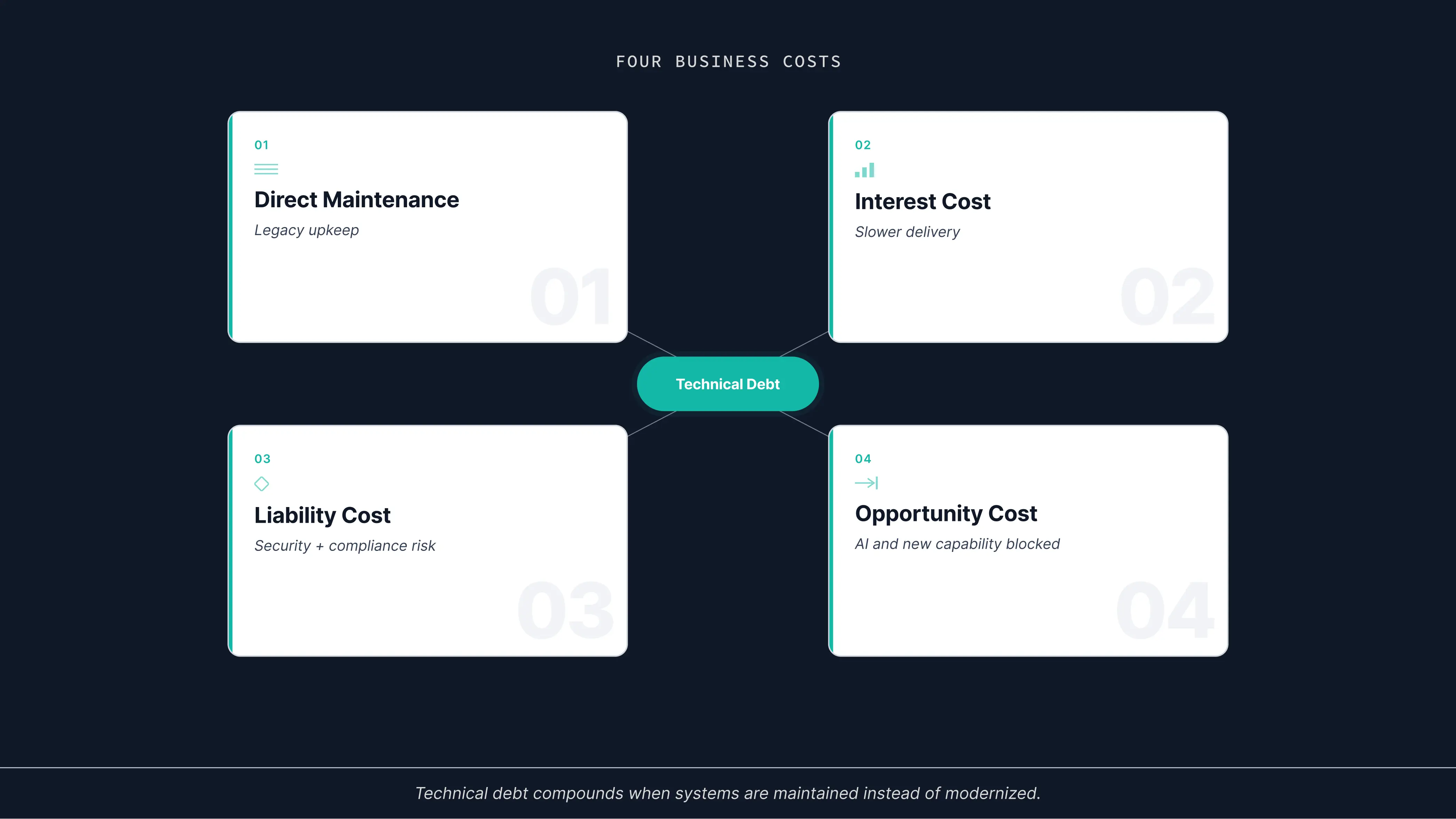
The name “technical debt” makes it sound like a software engineering concern, but it isn’t. It is rather a business issue: the accumulated cost of every shortcut taken, every system not refactored, every integration held together by a workaround that became permanent. And according to the data, it is getting significantly worse — not better.
The scale of the problem
Deloitte’s 2026 Global Technology Leadership Study estimates that technical debt accounts for 21% to 40% of an organization’s IT spending. For large enterprises, that is hundreds of millions of dollars per year spent maintaining systems rather than building new capability. The average global enterprise wastes over $370 million per year due to its inability to efficiently modernize legacy systems, according to Pegasystems’ 2025 research across more than 500 IT decision-makers. The accumulated technical debt in US enterprises alone has reached $1.52 trillion.
In 2024, Forrester predicted that 75% of technology decision-makers would expect technical debt to rise to a “severe” level in 2026. That number was 50% in 2025. The trajectory is not improving.
In banking — the sector where the problem is most visible — up to 70% of IT budgets are now spent maintaining legacy systems and managing technical debt, according to Accenture’s Banking Trends 2026 report. That leaves only 30% for everything else: new products, new features, regulatory adaptation, AI integration. It is not enough, and the teams building on those budgets know it.
Why it slows everything down
Technical debt does not just cost money. It slows time-to-market in ways that compound with scale. We observe that enterprise organizations that proactively reduce technical debt realize a 20-30% faster time to market on new digital initiatives. For a fintech company where competitive windows close in months, that speed difference is existential.
The mechanism is familiar to any senior engineer: a “small change” requires understanding a system no one has touched in three years. Documentation is missing or outdated. The change is made. Three other things break. The fix to those things introduces two new issues. What should have been two days of work becomes two weeks of archaeology.
IBM Institute for Business Value research found that of 1,300 senior AI decision-makers surveyed, those whose companies had ignored technical debt saw returns on AI projects drop by 18-29%, with timelines expanding by as much as 22%. This is the most current and consequential manifestation of the problem: AI sits on top of data. If the data architecture is fragmented, siloed, or inaccessible because of legacy system constraints, the AI investment fails — not because the AI is bad, but because the foundation it requires doesn’t exist.
Gartner predicts that by 2027, 80% of technical debt will be architectural in nature — meaning it is baked into the fundamental design of how systems are structured, not just in code quality or documentation. Architectural debt cannot be fixed with a sprint. It requires deliberate redesign, and it is something that is part of our culture reflected in the Unibrix manifesto.
What it actually looks like in fintech
For example, eBay undertook a platform modernization effort specifically to address latency problems in its payments and checkout infrastructure caused by legacy system complexity. Users had been experiencing latency during payments and checkouts leading to a subpar customer experience, and technical debt constrained the company’s ability to scale and innovate.
For fintech companies, the same pattern shows up in slower card authorization response times, inability to add new payment corridors without months of integration work, compliance reporting that requires manual reconciliation because data is scattered across systems, and inability to deploy AI features because the underlying data model was designed before real-time processing was a requirement.
The path out
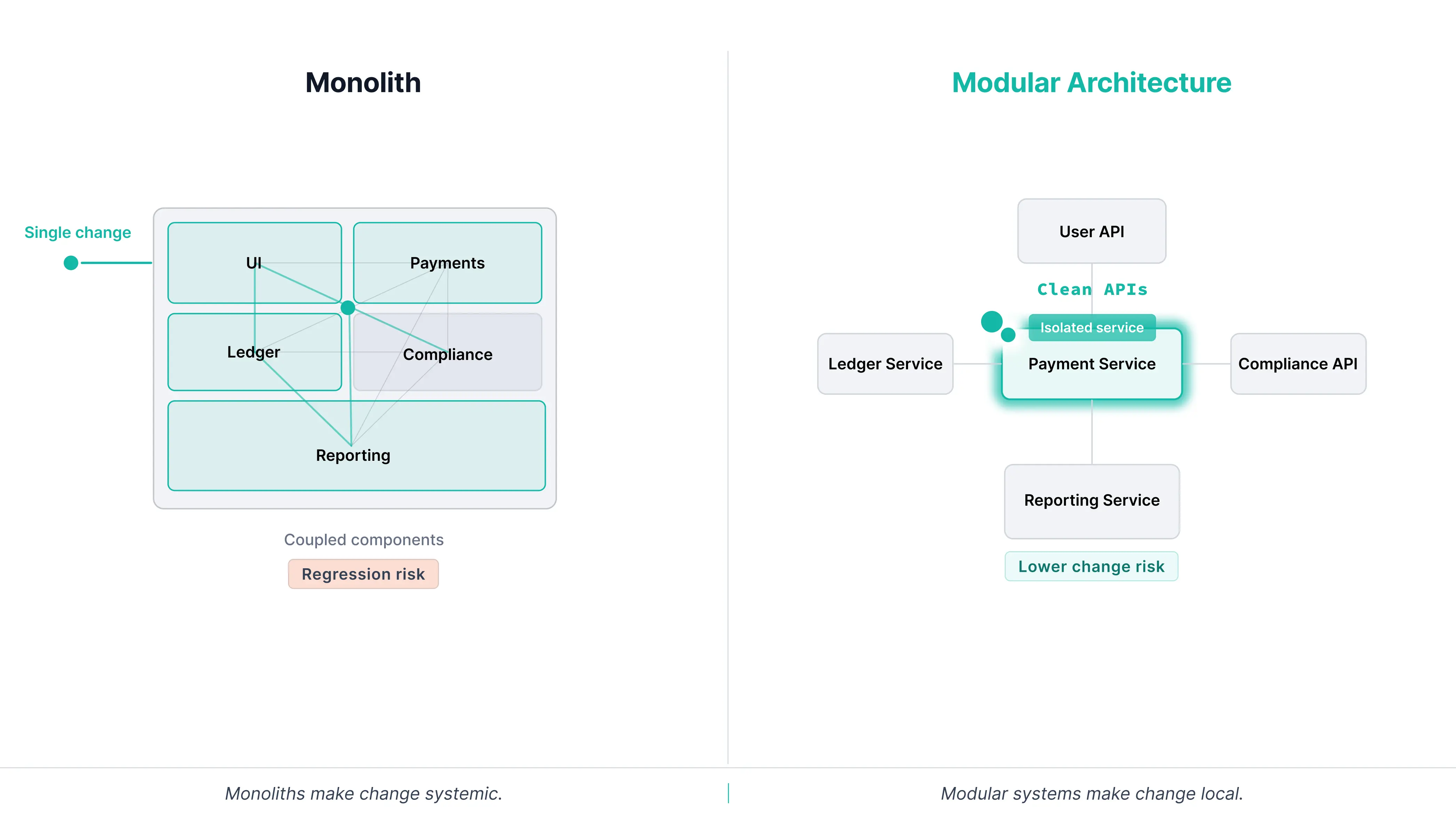
The answer is not a big-bang rewrite. Companies that have successfully reduced technical debt — recovering capability rather than just managing cost — share a common approach: modular decomposition over time, identifying the highest-value components to isolate first, building clean APIs between old and new systems rather than waiting for full migration. IBM research shows that enterprises that fully account for the cost of addressing technical debt in their AI business cases project 29% higher ROI than those that don’t.
The fastest-moving enterprises are not the ones with the cleanest codebases by accident. They are the ones that made a deliberate architectural bet — decomposing legacy systems into modules with defined interfaces — before the AI and competitive pressures arrived, not after.
Is technical debt slowing your product roadmap? Unibrix builds and modernizes software with modular architecture — decomposing legacy systems into maintainable, extensible components without requiring the big-bang rewrite that most teams fear. The teams that move fastest are the ones that solved the architecture problem, not the ones with the most engineers.

Moombix

Kennitalan

Wooskill
technical assessment,
and project scoping.
UI/UX design, and
technical specifications.
reviews, and continuous
integration.
testing, security audits,
and bug fixes.
documentation, and
ongoing support.