The Hidden Cost of Healthcare Software
Bad healthtech architecture costs more than the build. Here’s what the numbers say.
The Hidden Cost of Healthcare Software
Most healthcare software projects don’t fail at launch. They fail slowly — in the form of delayed care, burned-out clinicians, seven-figure breach costs, and AI integrations that never quite work because the foundation underneath them was wrong from the start.
The architecture decision you make in week three of a build doesn’t show up as a problem until month eighteen. By then it’s expensive to fix, politically difficult to admit, and medically risky to ignore. Here’s what the research says — and which products are getting it right.
What Bad Architecture Actually Costs
The numbers are not abstract: 45% of healthcare apps fail to scale due to poor architecture, leading to downtime and user churn, according to a 2024 Gartner report. Microservices-based architectures, by contrast, reduce downtime by 30%.
That’s the product risk. The security risk is worse.
The average data breach in healthcare now costs $7.4 million, according to a 2025 IBM report — and 97% of organizations with AI-related security incidents lacked proper AI access controls.
And then there’s patient safety. Among healthcare organizations that experienced cyberattacks in 2025, 72% reported disruption to patient care. Mortality rates at affected organizations increased from 26% in 2024 to 32% in 2025 — a direct line from infrastructure failure to clinical outcome.
These aren’t edge cases. They’re what happens when security and architecture are treated as afterthoughts rather than design foundations.

The Legacy Problem No One Budgets For
65% of healthcare systems name legacy technology as their biggest IT challenge. Despite nearly 75% of providers increasing IT spending, most still struggle to integrate point solutions into their existing EHRs — leading to wasted investments and millions lost on projects that rarely deliver meaningful results.
The pattern is familiar to any CTO who has inherited a health platform built in increments: every new feature requires a custom connector. Every connector breaks when something upstream updates. And the team spends more time maintaining glue than building a product.
The 2025 Healthcare Data Quality Report found that 68% of organizations rate the quality of their own patient data as “mixed” or “poor.” You can’t build reliable AI on data you don’t trust. And you can’t trust data that lives in disconnected silos with no governance layer.
Where AI Runs Into the Wall
The pitch for AI in healthcare is compelling. Faster diagnosis, reduced admin burden, earlier detection of deteriorating patients. The reality is that most AI deployments stall not because the model is bad — but because the data layer underneath it is fragmented, non-standardized, or locked inside a legacy EHR with no clean API surface.
Interfaces that require clinicians to hunt for information or complete multiple navigation steps delay patient care. In emergency scenarios, poor interface design can be the difference between timely intervention and a preventable adverse outcome. The cognitive load imposed by poorly designed clinical technology forces clinicians to divide attention between patient care and system operation.
This is the hidden cost nobody puts on the project brief: clinician cognitive load as an architectural failure. Every extra click is a decision tax. At scale, across thousands of patient encounters a day, that adds up to worse care.
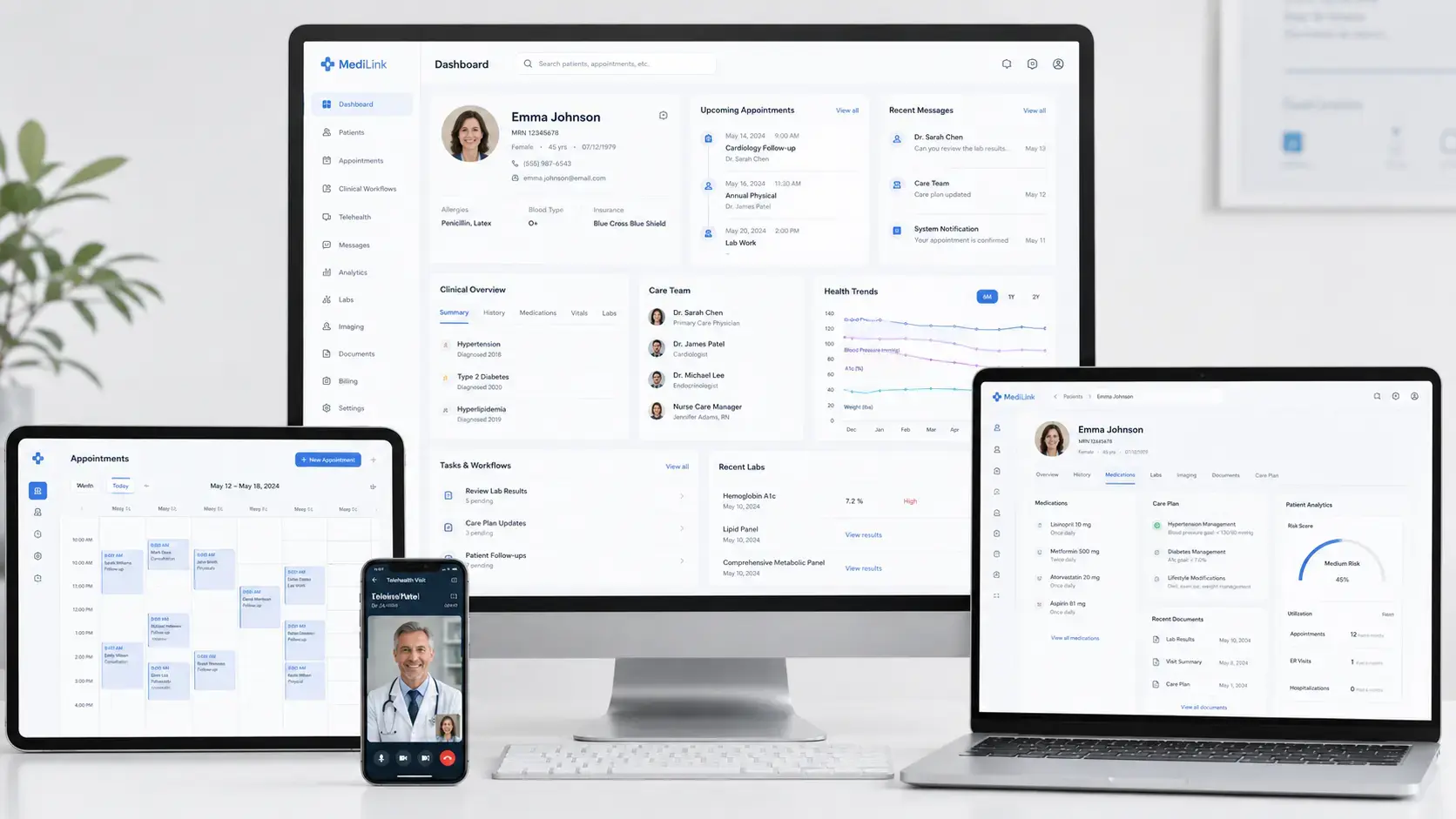
The fix isn’t a better UI. It’s a modular system where each component — data, workflow, clinical decision support — is independent, cleanly interfaced, and replaceable without touching the rest of the stack.
Products Building It Right
Microsoft Dragon Copilot — Ambient Clinical Documentation
What it does: Listens to physician-patient conversations and drafts clinical notes directly inside Epic — without the physician typing a word.
Dragon Copilot users report a 50% reduction in documentation time, 70% decrease in burnout and fatigue, seven minutes saved per encounter, and five additional appointments added per clinic day on average. More than 150 health systems have deployed it, including UNC Health and Lifespan.
What builders should notice: Dragon works because it’s not a standalone product — it’s deeply embedded into Epic’s existing workflow via SMART on FHIR. Dragon Copilot for nurses, announced in late 2025, extends the same ambient approach to nursing documentation — producing structured flowsheet entries and nursing notes without requiring the nurse to type during patient interaction. The AI doesn’t replace the EHR. It sits inside it, reading and writing through clean interfaces.
Azure Health Data Services — FHIR Infrastructure Layer
What it does: Manages FHIR, DICOM, and MedTech services in the cloud — the data plumbing that makes everything else possible.
Azure Health Data Services unifies clinical, imaging, device, and unstructured data using FHIR and DICOM standards. It connects directly to Azure Synapse Analytics, Azure Machine Learning, and Power BI — enabling analytics and AI on standardized, HIPAA-compliant health data.
What builders should notice: FHIR is becoming the baseline, not a differentiator. Epic MyChart now serves over 50 million patients with FHIR-enabled record access. Apple Health connects with 100+ health systems via FHIR to pull patient data directly into iPhones. If your platform doesn’t have a clean FHIR layer, you’re not just behind on compliance — you’re disconnected from the healthcare data ecosystem entirely.
UCSF + Ambience Healthcare — Ambient AI at Hospital Scale
What it does: AI-powered ambient scribe deployed across UCSF’s physician network — integrated into Epic via SMART on FHIR.
UCSF expanded its ambient AI scribe to 575+ physicians by early 2025, reducing documentation burden and improving note timeliness. The same AI infrastructure also shortened brain MRI scan times by 45% while maintaining diagnostic accuracy, and enabled 35,000+ self-scheduled visits — saving $161,000 in call center costs over three months.
What builders should notice: This isn’t a single product success story — it’s a platform story. UCSF runs H2O.ai, Luma Health, and Ambience Healthcare on one HIPAA-compliant infrastructure layer (Versa AI), all integrated into Epic via SMART on FHIR. The AI works because the data layer underneath it is unified. That’s the architecture principle in practice.
Epic + SMART on FHIR Ecosystem — The Integration Standard
What it does: The platform that most serious AI deployments in US healthcare are being built on top of — not because Epic is perfect, but because it’s where the data lives.
Google Cloud Healthcare API and Azure API for FHIR allow health systems to store EHR data in a FHIR store and apply machine learning directly. AWS HealthLake uses NLP to convert unstructured clinical text into FHIR-coded data. In all these cases, FHIR serves as the shared language that lets AI models plug into live clinical data.
What builders should notice: If you’re building a healthtech product that needs to integrate with hospital systems, SMART on FHIR is not optional. It’s the interface contract that lets you exist in the ecosystem without rebuilding from scratch every time a health system uses a different EHR vendor.
The Pattern Across All Four
Every product here succeeds for the same structural reason: the AI layer sits on top of clean, standardized, API-accessible data. The architecture is modular. Each component is independently upgradeable. And the integration doesn’t ask clinicians or health systems to change their workflow — it fits into what already exists.
None of them tried to replace the EHR. None of them bolted AI onto a monolithic stack and hoped for the best.
For CTOs Building in Healthtech
The hidden cost of bad healthcare software isn’t in the sprint estimate. It’s in the breach response, the EHR migration project that drags into year two, the AI feature that quietly never gets adopted because clinicians don’t trust the data it’s running on.
Design for modularity from the start. Build FHIR compliance in, not on. Treat the data layer as the product — not the UI. The AI follows the architecture. And in healthcare, bad architecture doesn’t just cost money. It costs care.
Unibrix builds secure modular software for healthtech, fintech, and AI products — with dedicated development teams and a component-based architecture mindset. Explore our Healthtech case.

Moombix

Kennitalan

Wooskill
technical assessment,
and project scoping.
UI/UX design, and
technical specifications.
reviews, and continuous
integration.
testing, security audits,
and bug fixes.
documentation, and
ongoing support.