EdTech Has a Retention Problem — Not a Content Problem
The biggest challenge in EdTech isn't content—it's retention. Learn how AI, product design, and behavioral systems keep learners engaged.
Education does not have a shortage of content. There is a shortage of reasons to come back tomorrow.
Coursera currently offers more than 10,600 courses from 350+ university and industry partners, while its wider network spans hundreds of organizations. The platform reaches subjects from computer science and healthcare to business and the humanities. Add YouTube, Khan Academy, universities’ own digital libraries, corporate academies, and thousands of specialist learning apps, and the basic problem becomes obvious: finding another video, course, quiz, or explanation is rarely the hard part anymore. Keeping someone learning is.
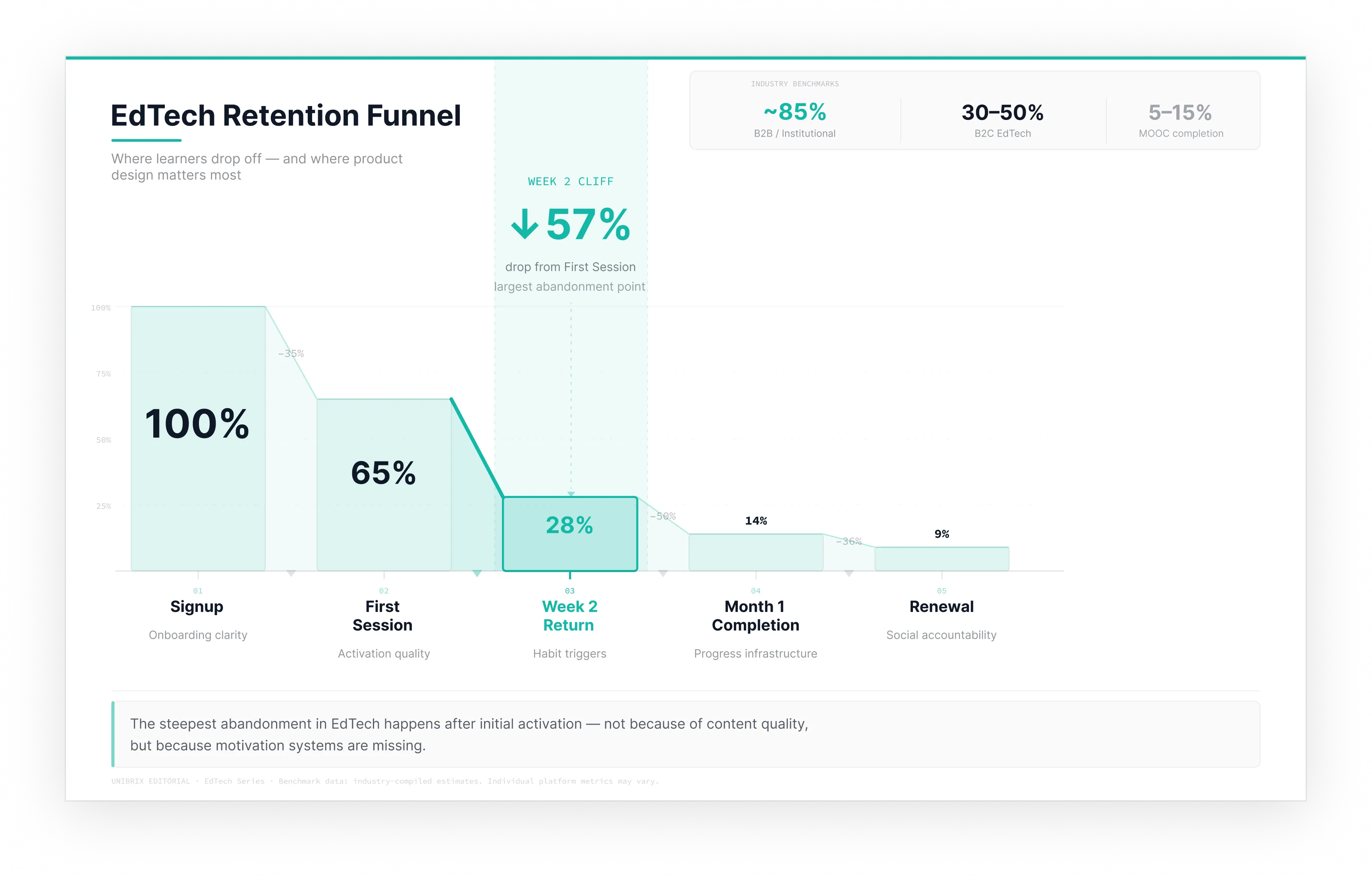
MOOCs provide the classic warning. Published research has commonly put their average completion rates at roughly 5%-15%. That number needs context — registering for a free MOOC is very different from enrolling in a paid university degree — but it still exposes a weakness in the “great content equals great product” assumption.
Our bold assumption: if learners are disappearing,
don’t automatically order more content.
Look into the product architecture first.
What the retention numbers actually show
2026 EdTech benchmarks, compiled from analysis of 180+ EdTech companies, make the structural divide visible: B2C consumer learning apps average 40% annual retention. B2B institutional tools average 85%. The 45-point gap is not driven by content quality differences but by the behavioral context in which the learning happens.
B2B EdTech is embedded in professional environments where completion is tied to employment obligations, manager accountability, and measurable skill certification. The product benefits from an external motivation structure it didnʼt build. B2C EdTech must supply its own motivation infrastructure — the triggers, rewards, progress signals, and social mechanisms that keep a learner returning when no one is watching.
Most EdTech products donʼt build that infrastructure. Instead, they build content delivery systems and assume motivation will follow from content quality. It doesnʼt. The reason learners drop off is not that the course wasnʼt good enough. It is that nothing in the product architecture made returning feel more compelling than not returning.
The global EdTech market is projected to grow at 13.9% CAGR through 2033, expected to reach $810 billion. The companies capturing that growth will not be the ones with the most comprehensive course libraries. They will be the ones that solve the behavioral architecture problem that content-first platforms leave unaddressed.
What retention-driven product architecture looks like
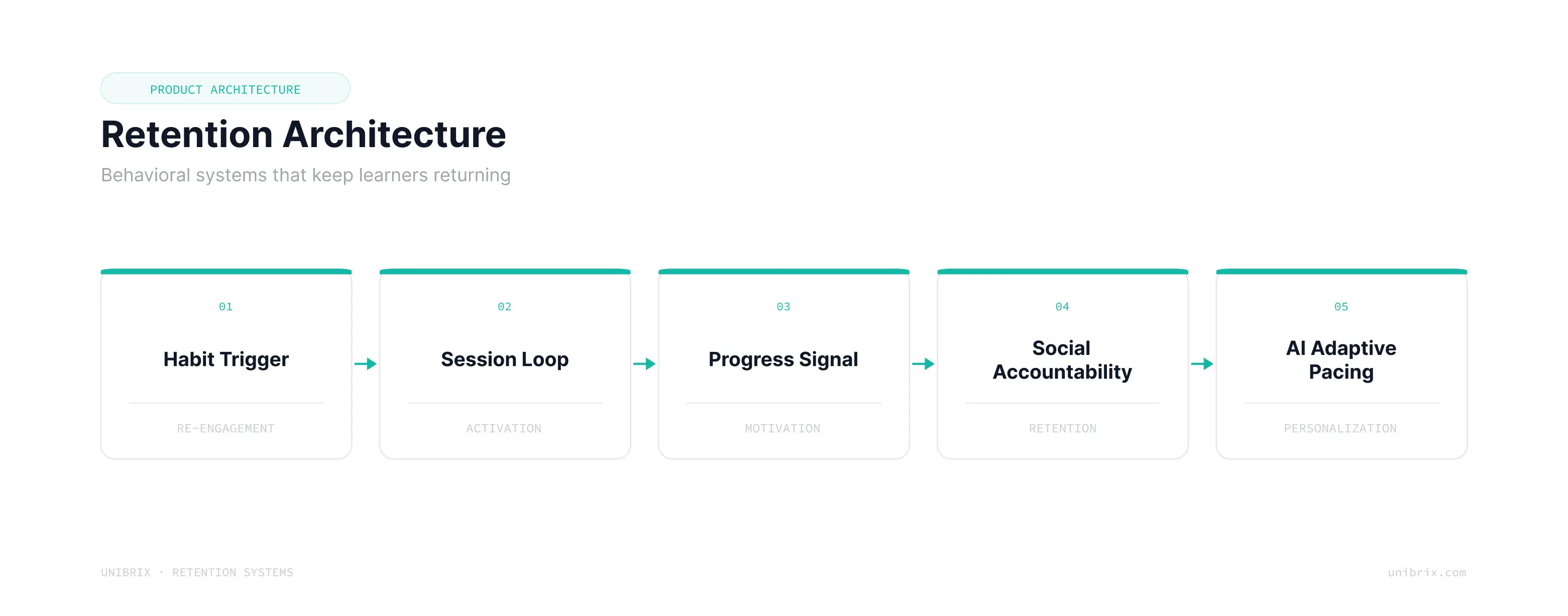
The EdTech products with above-benchmark retention share a common set of product mechanisms — none of which are primarily about content.
Progress infrastructure. Learners who can see how far theyʼve come are more likely to continue than learners who can only see how far they have to go. This requires explicit progress representation — not a percentage bar, but milestone markers that make incremental progress feel concrete. “Youʼve completed 3 of 8 modules” is less motivating than “You can now build a basic API in Python. Next: adding authentication.” The progress signal needs to be about capability gained, not content consumed.
Habit formation mechanics. Duolingo’s streak is a classic EdTech example: it gives users a simple reason to return every day, while loss aversion makes breaking the streak feel more costly than maintaining it feels rewarding. That can sustain daily engagement even when the content itself is not the main driver. The weakness is that a streak can reward opening the app rather than actually learning. Stronger EdTech products tie habit mechanics to meaningful progress, so the streak represents real practice, not just attendance.
Social and accountability layers. The research is consistent: learners in cohorts or with accountability partners complete at significantly higher rates than solo learners. This is not about adding a discussion forum (which most EdTech platforms have and most users ignore). It is about creating a small-group social structure where individual progress is visible to others — and where the social cost of not continuing is real. Coding bootcamps understood this earlier than most; many of them maintain cohort-based structures precisely because the social contract of the cohort drives completion that content alone cannot.
AI-driven personalization and pacing. The one-size-fits-all course sequence assumes all learners arrive with the same prior knowledge and learn at the same pace. They donʼt. Platforms with adaptive learning systems — which adjust the sequence, depth, and pacing of content based on demonstrated mastery — show materially higher completion rates. Khan Academyʼs mastery-based progression model is the most documented example. Duolingoʼs spaced repetition algorithm applies the same principle to language learning.
The product problem, restated
A single percentage-point increase in retention at a mid-size EdTech platform translates to millions of dollars in annual revenue, according to analysis of university EdTech implementations. The business case for solving the retention problem is clear: the obstacle is that most EdTech companies are organized around content production rather than product engineering — and retention is an engineering problem.
The platforms winning in 2026 are not the ones launching courses. They are the ones launching behavioral systems in which courses sit.
Building an EdTech platform that keeps learners coming back? Unibrix builds product systems with retention architecture built in — adaptive learning engines, progress infrastructure, gamification mechanics, and the notification systems that bring learners back at the right moment. Content without retention infrastructure is a library, not a product.
[[modal-button]]

Moombix

Kennitalan

Wooskill
technical assessment,
and project scoping.
UI/UX design, and
technical specifications.
reviews, and continuous
integration.
testing, security audits,
and bug fixes.
documentation, and
ongoing support.