Unibrix

Cases / Marketplace / Jules

Get in touch
LET'S BUILD

Ready to start your project?

Tell us about your challenge. We'll engineer a solution that scales with precision.

KNOWLEDGE REPOSITORY

Jules

[ PRODUCT PLATFORM & INTERNAL SYSTEMS ]

Designing and delivering a structured product foundation and internal tools to support early-stage growth and operational efficiency.

CATEGORY
Marketplace / Business Services
TIMELINE
2024-2026
COMPONENTS
Product design, internal tools, system architecture
STATUS
● DELIVERED
SERVICES PROVIDED
Product Discovery
UX/UI Design
Front-end Dev
Back-end Dev
QA
Full Delivery
Workspace with a tablet displaying a user interface with data tables, a smartphone showing a login screen for JULES Energy Specialists, wireless earbuds, keyboard, coffee cup, notebook, and pen.
01
STEP 01 — Project overview

This project focused on supporting Jules at an early and critical stage, where product direction, internal processes, and technical foundations needed to be clearly defined.

Instead of building isolated features, the work centered around creating a coherent system that could support day-to-day operations, guide future development, and scale without introducing unnecessary complexity.

Primary focus
Product structure and feature definition
Internal operational tools
System architecture foundations
Scalability from an early stage
What we delivered
Product discovery and system definition
UX architecture and interface design
Full front-end and back-end implementation
Internal tools supporting operations
End-to-end delivery and QA
02
STEP 02 — CHALLENGES IDENTIFIED

Assembly Requirements

REQUIRED CAPABILITIES
A
Engagement. Balancing usability and functionality for both external users and internal stakeholders.
B
Structure. Defining a clear product and system structure without overengineering early-stage solutions.
C
Scalability. Ensuring the platform could grow without requiring a rebuild of core logic or architecture.
03
STEP 03 — ASSEMBLY PROCESS

Solution Architecture

MODULE INVENTORY (4 COMPONENTS)
MODULE 3.1
● PRODUCT SYSTEM

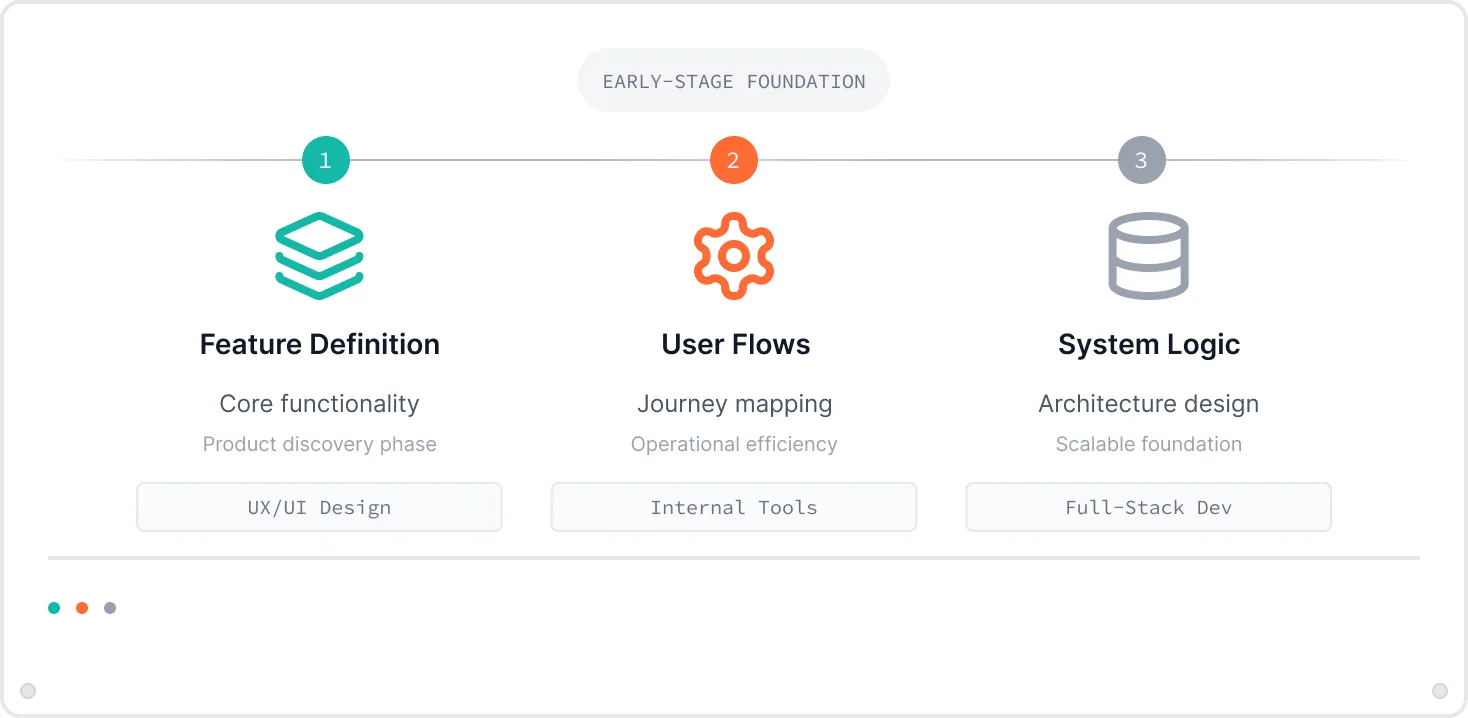
A structured product architecture was created to define key features, user flows, and internal logic, ensuring consistency across design and development.

Diagram showing early-stage foundation steps: Feature Definition for core functionality and UX/UI design, User Flows for journey mapping and internal tools, and System Logic for architecture design and full-stack development.
MODULE 3.2
● INTERNAL TOOLING

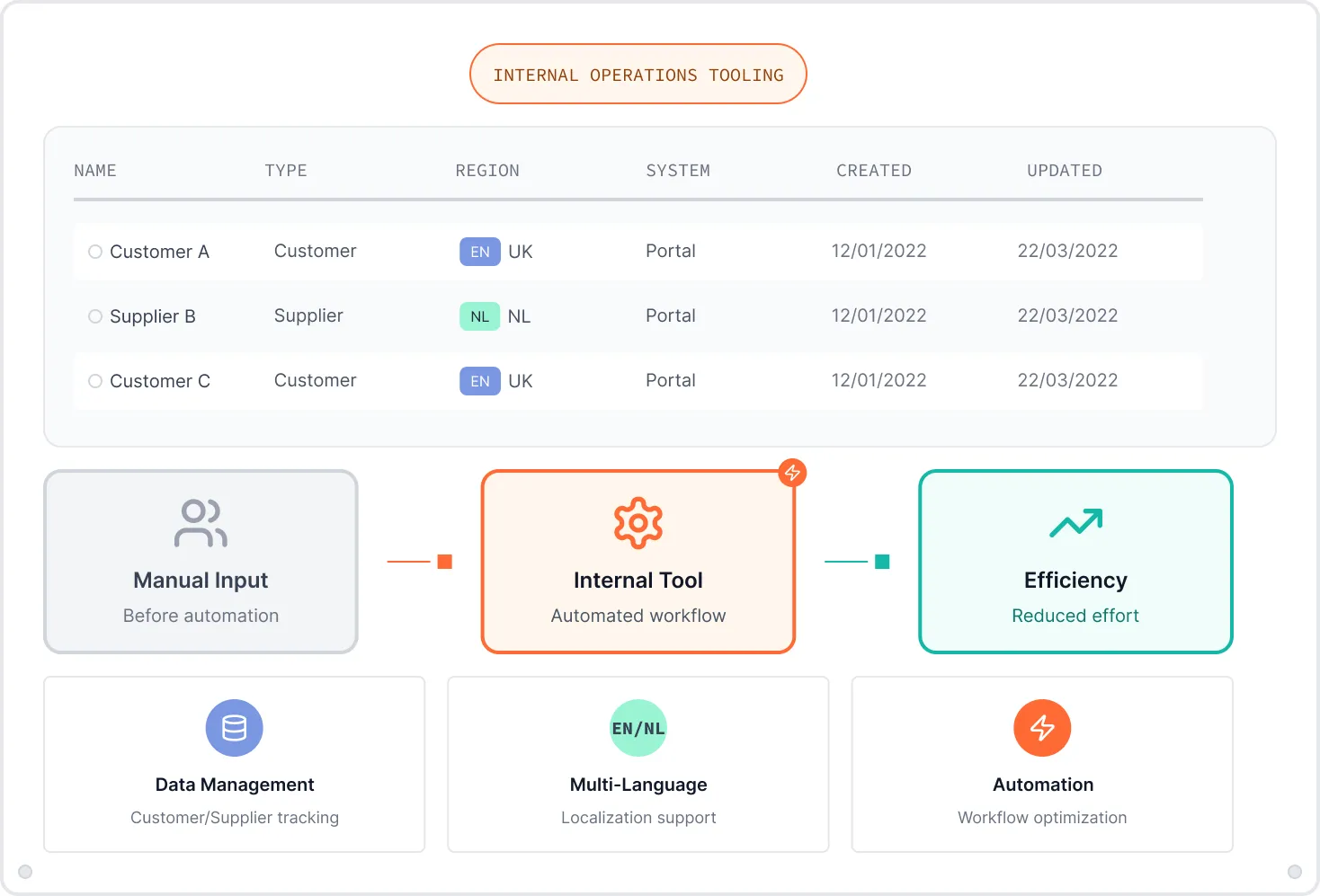
Custom internal tools were developed to support operational workflows, reduce manual effort, and improve efficiency.

Internal operations tooling interface showing customer and supplier data with regions and systems, workflow steps for manual input, internal tool, and efficiency, and features like data management, multi-language support, and automation.
MODULE 3.3
● PLATFORM FOUNDATION

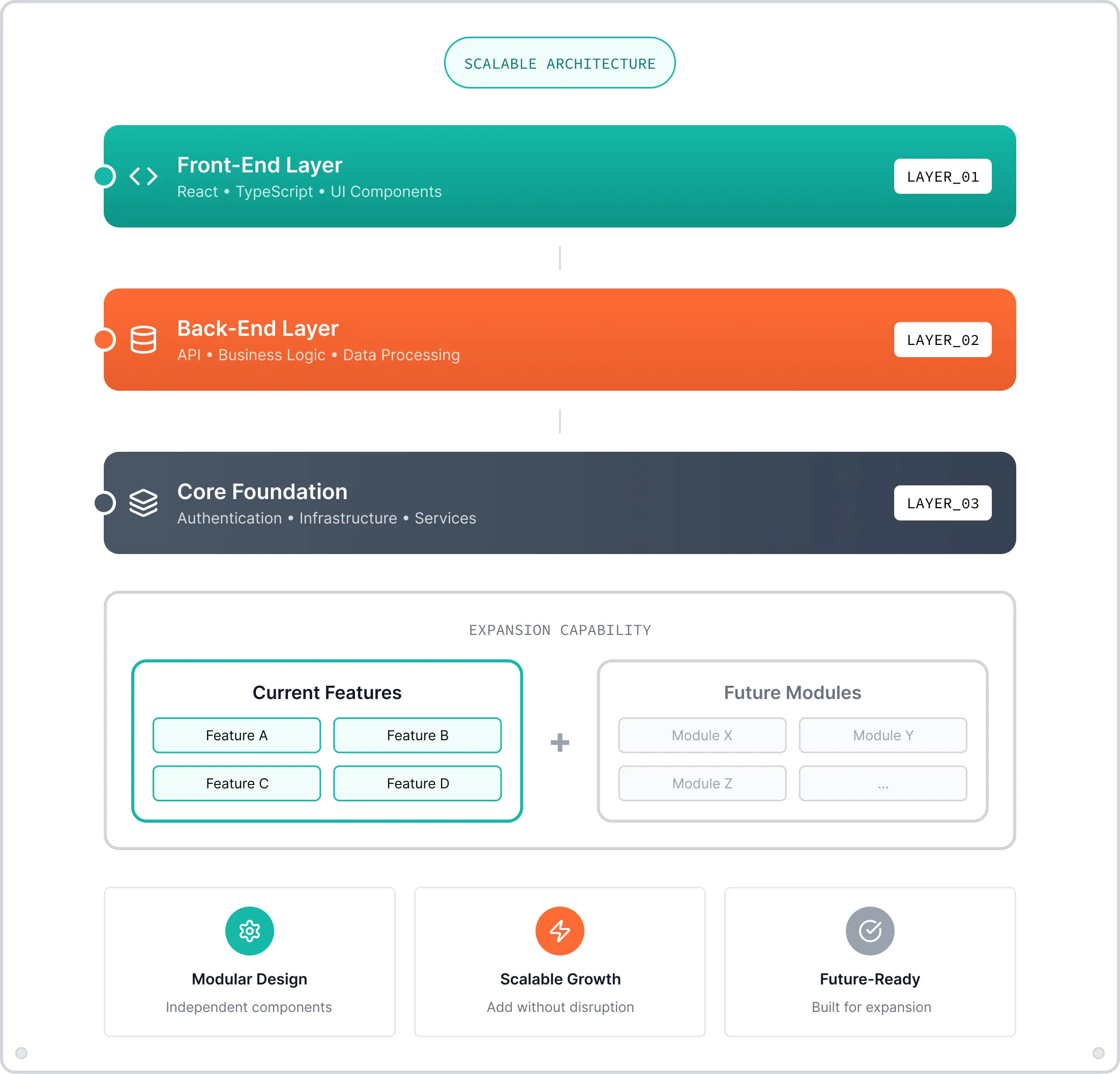
The platform foundation was built to support future expansion, allowing new features to be added without disrupting existing functionality.

Diagram of scalable architecture showing three layers: Front-End Layer with React, TypeScript, UI Components; Back-End Layer with API, Business Logic, Data Processing; Core Foundation with Authentication, Infrastructure, Services. Expansion capability includes current features A, B, C, D and future modules X, Y, Z. Highlights modular design, scalable growth, and future-ready expansion.
04
STEP 04 — ASSEMBLY COMPLETE

Delivered Impact

PERFORMANCE OUTCOMES
A
Established a structured product foundation
A
Improved internal operational efficiency
A
Enabled scalable platform growth
ASSEMBLY PHILOSOPHY
We don't just code.
We build systems.
Piece by piece,
designed to snap perfectly
into your vision.